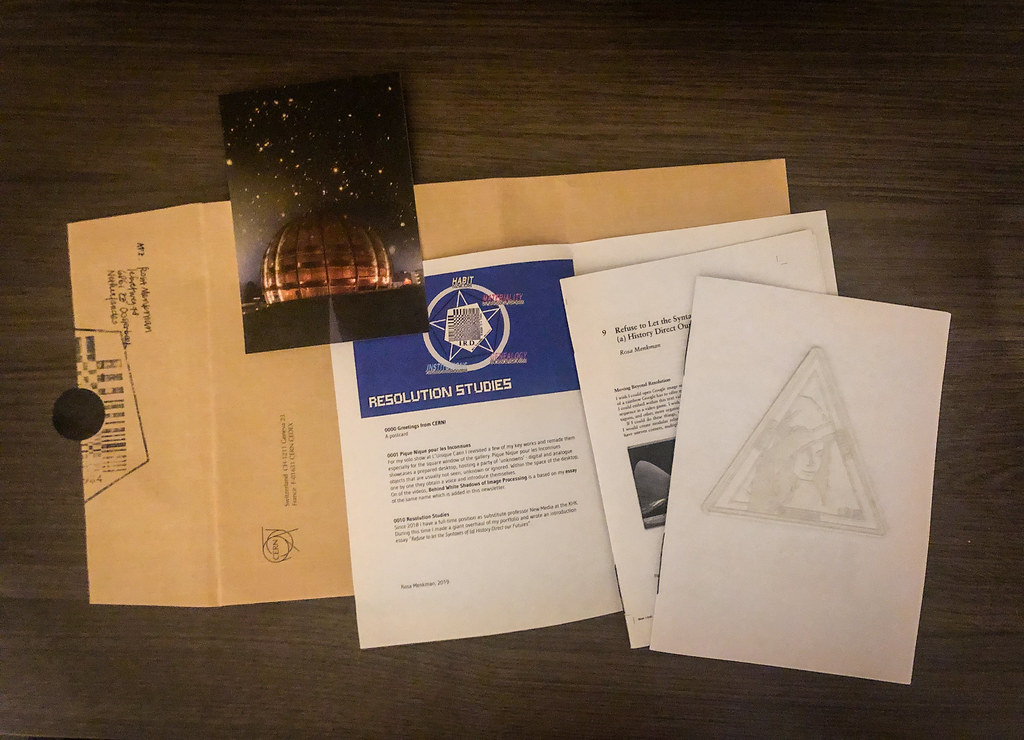
Dutch artist Rosa Menkman has been selected as the winner of the first Collide International award in Barcelona alongside four Honorary Mentions “The primary objective of Arts at CERN is to create extraordinary opportunities for dialogue and exchange between artists and scientists, and to encourage significant connections between creative minds in a fundamental research environment. I am particularly proud to announce the winners of the first Collide International prize in collaboration with the city of Barcelona,” says Monica Bello, head of Arts at CERN. “Here at CERN, we value diversity and exchange, across communities and countries. It is an inherent part of our laboratory’s culture and essential to the success of our research. We appreciate the strong partnerships that now allow us to welcome new artists to connect with our community. I am excited to see what they will achieve together with our scientists,” says Charlotte Lindberg Warakaulle, CERN’s Director for International Relations. According to the jury, comprised of Monica Bello, Arts at CERN, Oriol Gual, director of La Capella in Barcelona, Joana Hurtado, director of Fabra i Coats and Helga Timko, CERN physicist, the winning artist demonstrated a sophistication of concept and approach. Menkman’s topic focused on the idea of resolution, which resonates with CERN’s quest to perform research from the smallest to the largest scale. They found Menkman’s argument about the significance and purpose of scientific measurement and how information is filtered in and out of an experiment inspiring. The artist will be invited to CERN in Geneva for two months to explore these topics, after which she will work for a month on a 3D video production at Fabra i Coats. ─╟╨╬╥▐╠─▀ ─╟╨╬╥▐╠─▀ ─╟╨╬╥▐╠─▀ ─╟╨╬╥▐╠─▀
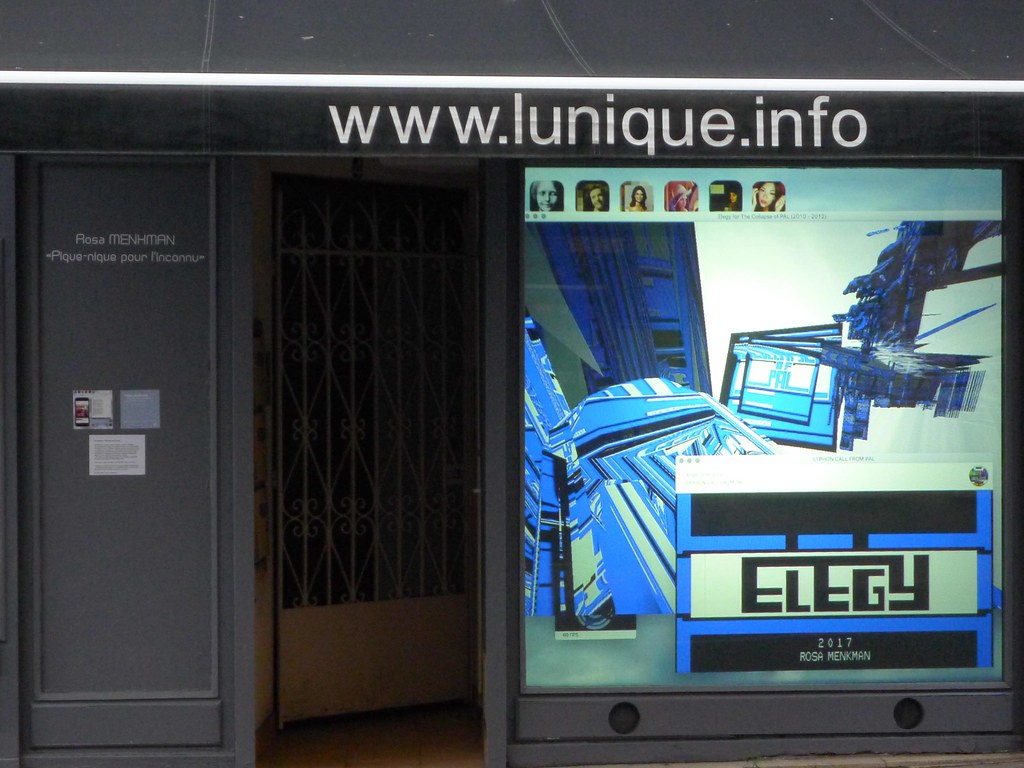
For L’Unique Caen Menkman revisited a few of her key works and remade them especially for the square window of the gallery.
Pique Nique pour les Inconnues showcases a prepared desktop, hosting a party of ‘unknowns’ - digital and analogue objects that are usually not seen, unknown or ignored. Within the space of the desktop, one by one they obtain a voice and introduce themselves.
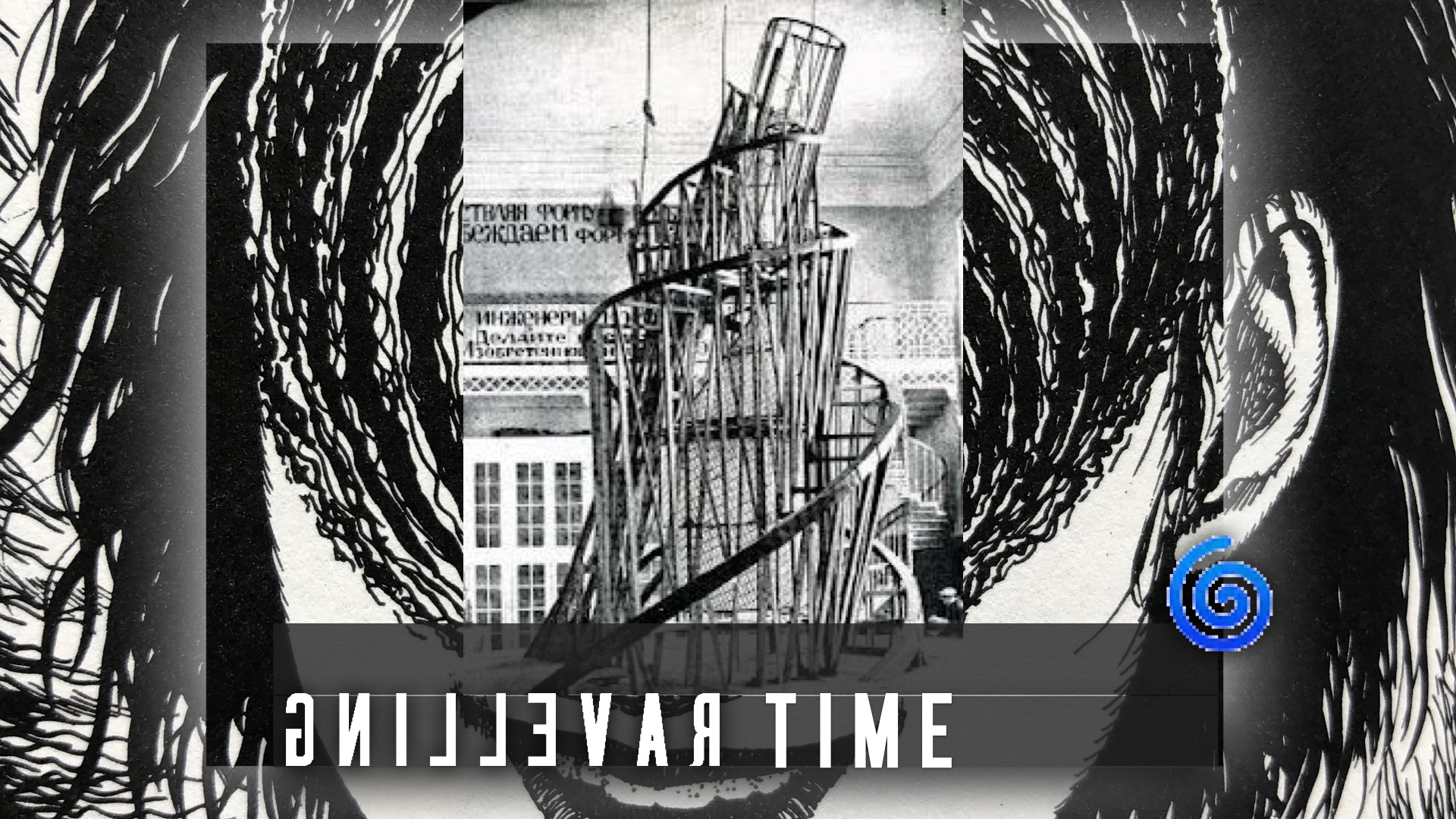
Alternative formats: Manifestos From the extinvion rebellion to Xenofeminism, Occupy Wallstreet to Black Lives Matter or Glitch to #Additivism - all these movements have used manifestos to announce themselves to the world. The manifesto genre is by definition timely and politically focused. It criticizes a present state of affairs but also announces its passing, proclaiming the advent of a new movement or even of a new era. Manifestos are often a call for a new vision, approach, program, or genre: they are the site of political, cultural and social experimentation in our contemporary world. Manifestos exist to challenge and provoke - to enhance conscious self-expression and empowerment. But how to write a contemporary manifesto in 2019? How to combine a call for action with ciritical digital design to fundamentally expand the character and scope of the genre itself? Tokyo Threading. A presentation given at the Sony Centre, Tokyo for Media Festival Japan. It matters what threads are used to construct a garment: using a thread that is stronger than the material that is sewn (the fabric) can end up causing rips in the material. During my time in Japan I had many encounters with Japanese digital artists who taught me about the importance of how to thread message and material together in very considerate, new ways of presenting. AR, VR and ‘empathy’. A presentation for Impakt, Utrecht, Netherlands. Impakt asked me to give a short presentation on AR, VR and empathy. VR - or ‘the empathy machine’ - has often been used to tell the story of young refugee girls. Can VR also provoke empathy without the exploitation of minor immigrant girls? And what is so good about empathy - what do we win with empathy if we do not practice compassion, sympathy, morality or other forms of ethical consideration? How easily do we cross the line from emphaty to commiserate disaster tourism? And what is the relation between AR and VR? Maybe the use of the world ‘reality’ a misnomer for what better could be understood as chimera or virtual imagination? Emojis - one day workshop The earliest known mobile phone in Japan to include a set of emoji was released by J-Phone on November 1, 1997. The set of 90 emoji included many that would later be added to the Unicode Standard, such as Pile of Poo 💩, but as the phone was very expensive they were not widely used at the time. In 1999, Shigetaka Kurita created the first widely-used set of emoji which was implemented on NTT DoCoMo's i-mode mobile Internet platform. Today, anyone can submit a proposal for an emoji character, but the implementation of new emoji is regulated by the Unicode Consortium. Yet every year 70 new emojis are chosen and implemented. How?: the voting members of the Unicode Constortium (Silicon Valley _ White Male Conservatives _ ) pay good �💵💴💶💰💷$ to have a vote. As a result, certain emojis are missing, while other emojis are the linchpin of controversy. Timetravelling - one day workshop With the advent of the digital, time is no longer what it used to be. Instances can be jumped, repeated or stamped: the digital has introduced a new experience of time. But before making such a statement, we first need to discuss the dimension of time.
According to Hillel Schwartz, first there was Aeon time. Aeon time is universally ongoing and impersonal time. As an eternal flux and flow it is always ‘just there’. Schwartz connects aeon time to background noise, the noise that has been there since the Big Bang, the noise that will always exist and is usually suppressed but remains part of any system. Secondly, Schwartz explains, there is Kronos, from which the term ‘chronology’ stems. Kronos refers to linear, one directional time, business time or incremental, daily routine time. Schwartz connects Kronos to repetitive noise, such as the noise of a dripping faucet. It is sickeningly rhythmic and does not move backwards. Finally there is Kairos, which is best described as the time of opportunity. This time is dangerous and thrilling, however it can also present itself subtly. Schwarz connects Kairos to the noise of revolution. It is the shriek of invention. The time when someone urges you to seize the moment.
But Schwartz is of course not the only one outlining a general definition of time. Many men have attempted to describe time before him, and many have after... Here Schwartz is merely a starting point to discuss and travel time. What can be images of time? And what other radical ideas of time are there? Posthuman Glossary - one day workshop
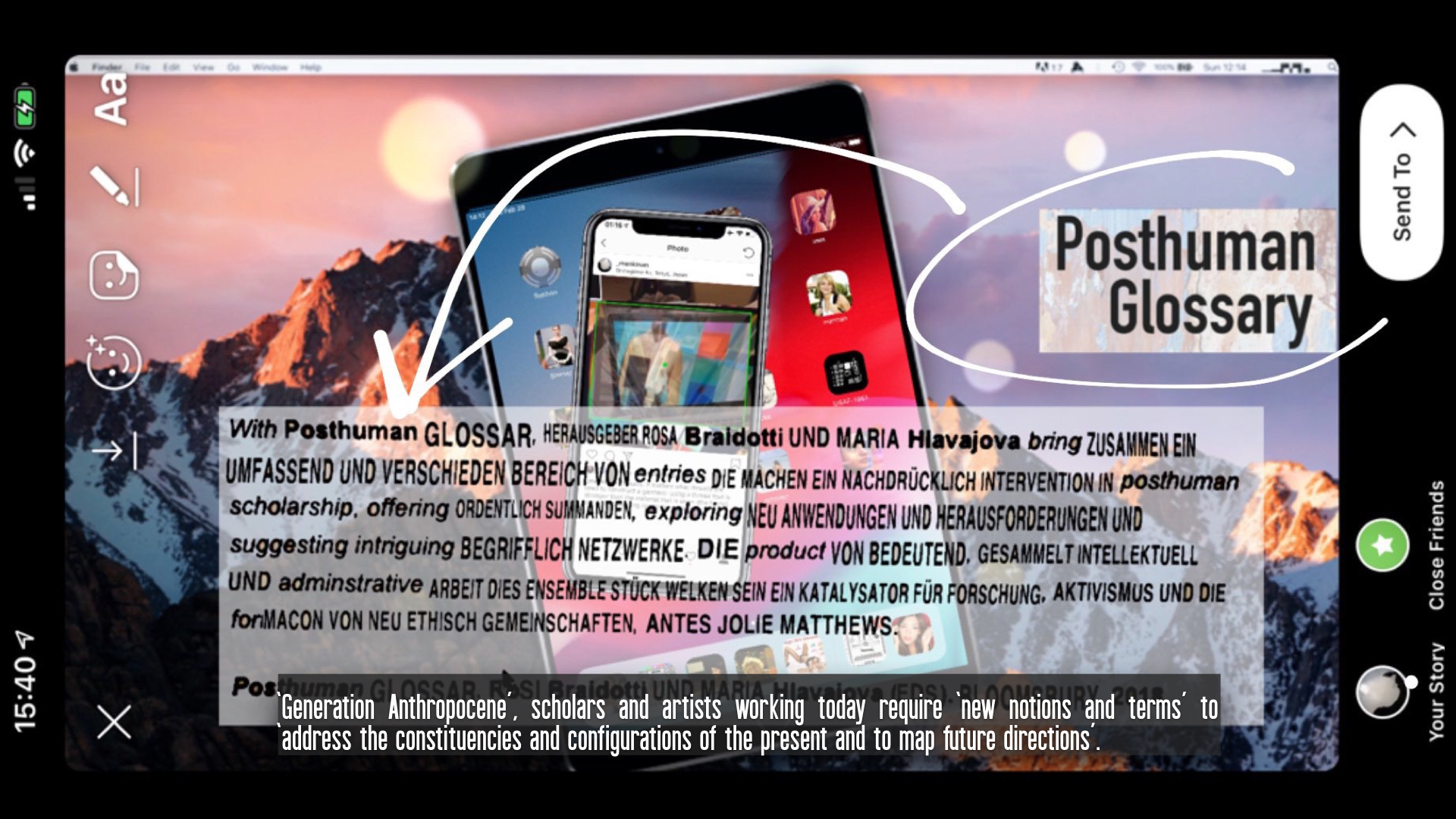
Posthuman Critical theory is a convergence of posthumanism and post anthropocentrism. In humanism the 'man' from the West sets the standards to measure all things. PCT rejects any nostalgia for humanism or the 'enlightened man of reason'. PCT also rejects to see the world as a hierarchy of species and human exceptionalism - as is celebrated in anthropocentrism. As a result, PCT pratices a ‘dis-identification of the familiar’.
Posthuman Critical Theory believes that:
subjectivity does not make an ‘anthropos’.
we need to create a sustainable notion of vitalist materialism - the belief that matter itself has vitality and is alive, no matter how lifeless it may appear to be. In doing so, objects and things are described as having agency (Jane Bennett / D&G).
we need to enlarge the scope of ethical accountability.
In short: Posthuman Critical Theory creates assemblages of human and non-human actors by combining feminist theory and Deleuze and Guattari's new materialist philosophy. Urgency is found in the Anthroposcene condition, which changes environmental, social economical, affective and psychical conditions and the violent and inhumane power relations that result from technological advances and a growing economic and social inequalities.
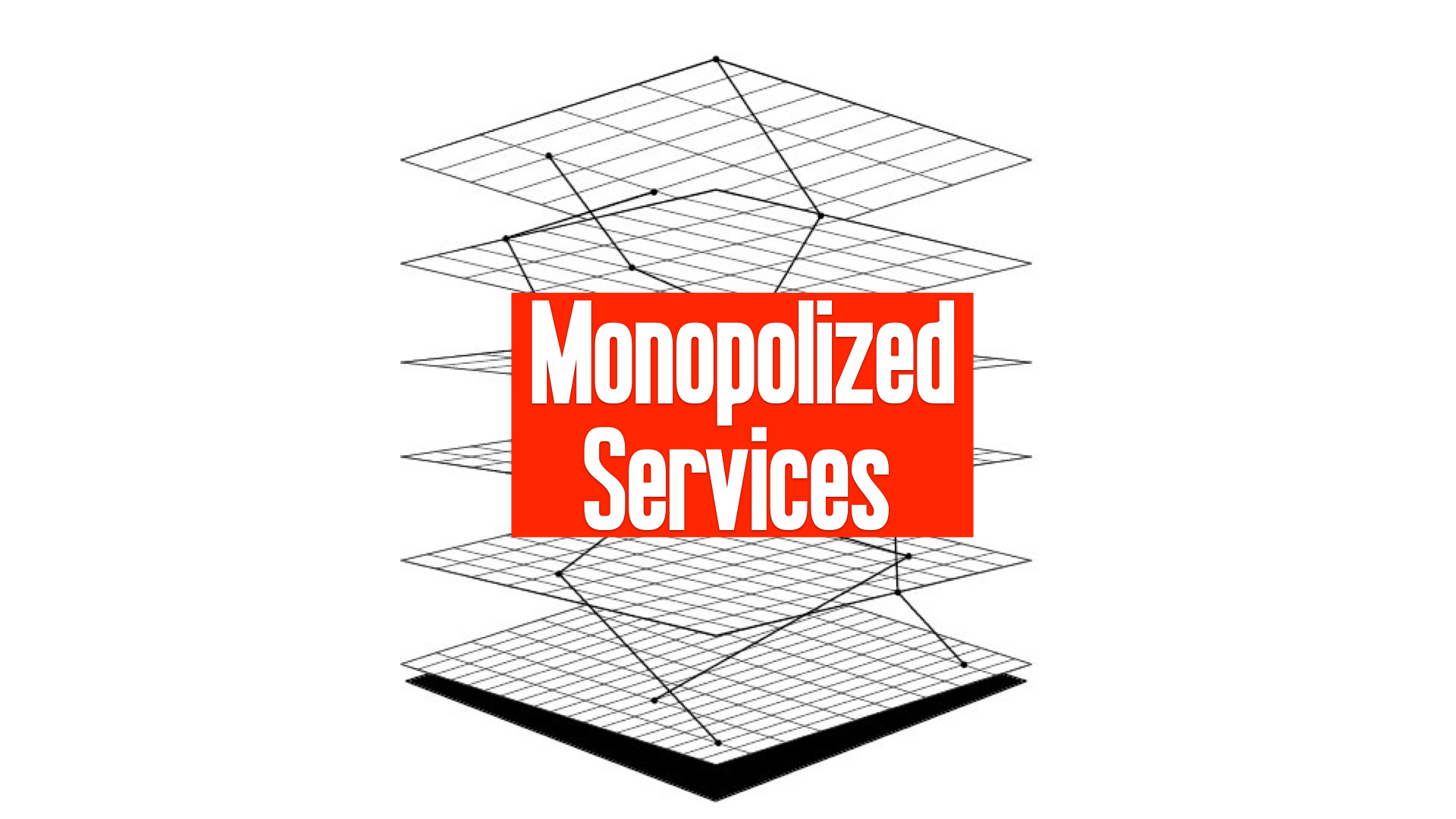
Critical (in Crtitical theory) refers to both being critical and creative. Critical is as a way to create cartographies of power, to account for and learn to relinquish unearned privileges and implicit power privileges. The creative side enlists the resources of the imagination and a new alliance of critique. Politically speaking, posthuman critical theory is a practical philospohy that aims at composing a 'missing people', to refashion and reshape the human to include all kinds of bodies (immigrant, of color, female, crip) Monopolized services (Included an Amazon Fullfilment centre visit with class)Monopolies and patents shape the (media) industry by strategies such as standardization, undercutting and prohibition. We talk about a few of these stories and about recent strategies of for instance Amazon, that by means of vertical and horizontal intergration has managed to cut out and bypass whole tiers in the chains of production and distribution. In doing so, the concept of ‘carriage’ - to carry over a particular product, service or provide a platform for a certain producer, has gotten renewed importance. Lets talk about money! Money is nothing. Even so, it can move everything. But how can nothing move everything? ...Its because the concept of money is made of agreements, of solidarity, of trust.Not just moral or political trust, but agreements that resonate in a sort of ‘condition’. (- paraphased from the K foundation burned a million quid) Money is often described in terms of time, freedom, or as an object rooted in the colonialist, modernist, or imperial projects of standardization.
But when do we actually learn to talk about money? Did someone teach you how money works, what are the rules of who gets to own, earn or safe money and how and what are the histories and ‘logics’ of inflation and value?
In fact, money is quite a fictual construct that is only worth something in ‘the right’ context or space - in the ‘condition’ that ascribes its worth. In this condition - or rather at the fringes of this space, the value of money also gives rise to alternative spaces, such as tax havens, Extrastates or bodies of de-regulated flows of capital.
a look at the slides of the subjects we spoke about during the Beyond Resolution Summer Semester course!
For L’Unique Caen I revisited a few of my key works and remade them especially for the square window of the gallery. Pique Nique pour les Inconnues showcases a prepared desktop, hosting a party of ‘unknowns’ - digital and analogue objects that are usually not seen, unknown or ignored. Within the space of the desktop, one by one they obtain a voice and introduce themselves.
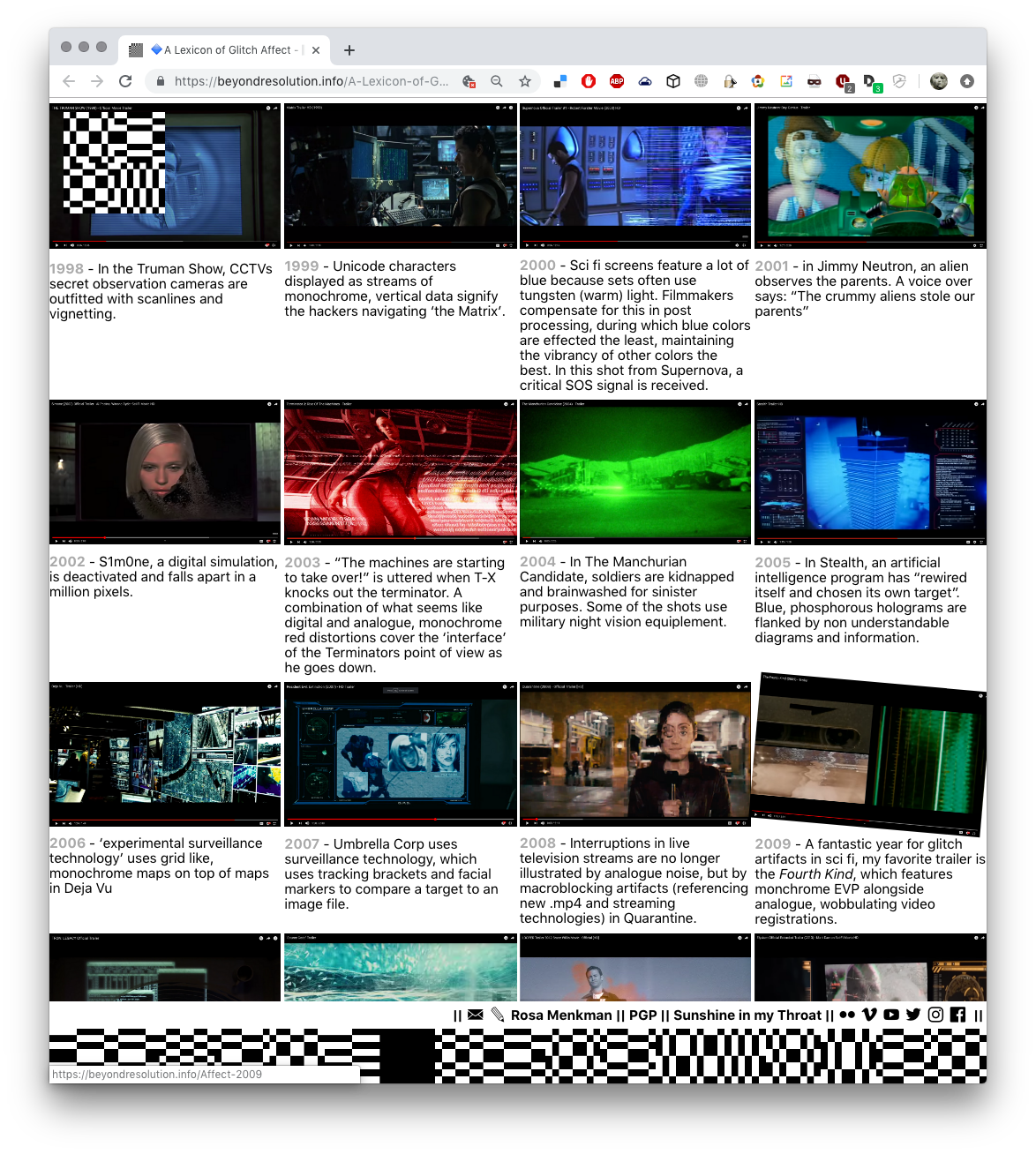
The Lexiconintends to offer an insight into the development of meaning in the aesthetics of distortion in Sci-Fi movies throughout the years, via an analysis of 1200 Sci-Fi Trailers. It will be released in tandem with a video essay.
Starting with trailers from 1978, I reviewed 30 trailers per year to obtain an insight into the development of noise artifacts in Sci-Fi from before the arrival of the home computer, to Sci-Fi adopting the contemporary aesthetics of our ubiquitous digital devices. My source for the trailers is the Internet Movie Database, where I accessed lists of the top-US Grossing Sci-Fi Titles per year. When watching these trailers I took screenshots whenever a distortion occured, and when possible interpreted them. Currently the database includes findings from research done into 630 trailers (1998-2018).
Underneath this very short essay I offer my most interesting findings per year. When you click an image, you get access to the noise artifacts per year. Glitch Art genre (2019) Every file format consists of a language, or ‘dialect’, according to which it is encoded, often also refered to as a compression algorithm. When we break this organization of data, by for instance glitching or databending, a new utterance or visual expression appears, showcasing the otherwise obfuscated organizations of compression on the surface of the image. These newly emerged images are often directly dismissed as 'garbage' or 'noise artifacts’, but sometimes, the results of these noise artifacts can in fact reveal exciting, unexpected new forms of expression or ‘visual slang’. It is these modes of expression that artists have named the genre of Glitch Art. But, to call glitch a genre suggests it is intelligible and that it follows certain norms or rules. From its beginnings, glitch art used to exploit medium-reflexivity, to rhetorically question technologies ‘perfect’ use, conventions and expectations. However, paradoxically, over time glitch art has become standardized into a genre that also fulfills certain expectations (oa. to rhetorically question the medium). This reflexive approach inherent in the materiality of the glitch tends to, as Katherine Hayles would assert, re-conceptualize the glitches’ materiality into an interplay between its ‘physical characteristics and its signifying strategies’. But glitch genres perform their reflection on digital materiality not just on a technological level. To really understand a glitch, each level of this notion of (glitch) materiality should be studied: the text as a physical artifact, its conceptual content, and the interpretive activities of artists and audiences. Distortions in Sci-Fi Distortions prompt the spectator to engage not only with themes, but also with complex subcultural and meta-cultural narratives and gestures, presenting new analytical challenges. In the Glitch Moment(um) (Institute of Network Cultures, 2010) I wrote that every form of glitch, either breaking a flow, or designed to look like a break from a flow, will eventually become a new fashion. As the popularization and cultivation of the glitch genre has now spread widely, I believe it is important to track the development of these processes in specific case studies and create ‘a lexicon of distortions’. New, fresh research within the field of noise artifacts is necessary. In an attempt to expand on A Vernacular of File Formats, I propose a lexicon that deconstructs the meanings of noise artifacts; a handbook to navigate glitch clichés as employed specifically in the genre of Sci-Fi.
Sci-Fi relies on the literacy of the spectator (references to media technology texts, aesthetics and machinic processes) and their knowledge of more ‘conventional’ distortion or noise artifacts. Former disturbances have gained complex meaning beyond their technological value; with the help of popular culture, these effects have transformed into signifiers provoking affect. For example, analogue noise conjures up the sense of an eerie, invisible power entering the frame (a ghost), while blocky-artifacts often refer to time travelling or a data offense initiated by an Artificial Intelligence. Interlacing refers to an invisible camera, while camera interface esthetics (such as a viewfinders and tracking brackets or markers around a face) refer to observation technologies. Hackers still work in monochrome, green environments, while all holograms are made from phosphorous blue light. And when color channels distort, the protagonist is experiencing a loss of control.
** This video is a placeholder; work in progress!!ˀ
Behind White Shadows of Image Processing is a video based on my essay of the same name and is on show now at the ICC Tokyo as part of "Alternative Views" in the Open Space.
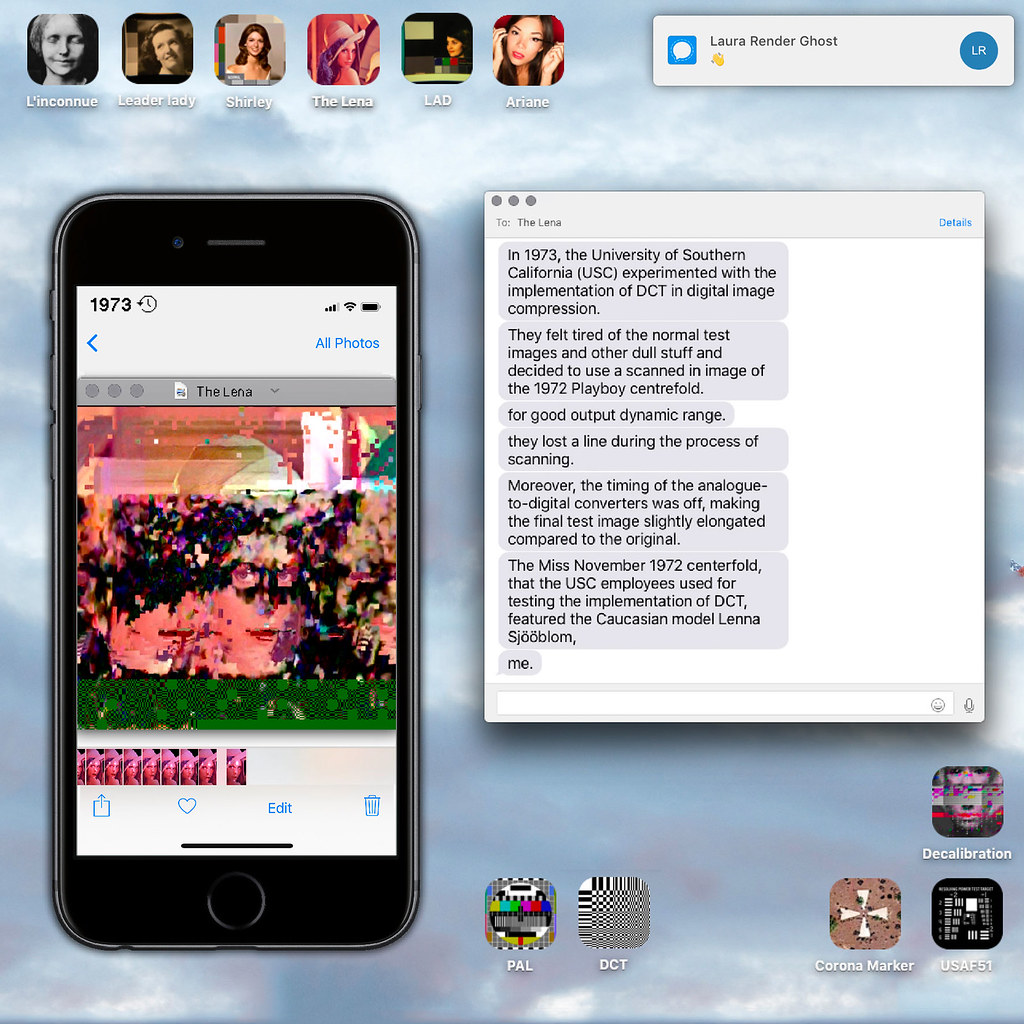
In Behind White Shadows, the "Angel of History" sends its friends and colleagues an email with the photos of two female figures attached. These two images, modelled after real women, are still seen by many people. However their name and identity remain unknown. The Angel writes: "While contemplating these images, I had to think about other women, whose faces were put through similar histories. Forever resonating within the realms of image processing - wether they chose this fate themselves or not. As it seems your face is amongst them, I wondered if you could share some of your insights." The Angel receives replies subsequently from the leader ladies, Lena, Ariane and a render ghost.
Alternative Views is an exhibition covering media art works and various expressions in the current media environment. It displays typical works in media and art, works incorporating contemporary technology, works with a critical perspective, works by emerging artists, and ongoing projects at research institutes. Furthermore, with commentary to help the understanding of the work, not only enjoy the work but also the current diversified media and the way of communication in the background, or the prospect for the future, the new sensitivity and the sense of beauty about the modern technology society We are aiming for an exhibition that will give us an opportunity to think
I finally found the time to update my publications page! fresh links, uploads, new publications all gathered in one URL : ) wooohooo what good birthday upgrades
Yesterday during the exhibition of our work in progress I gave a short presentation about my work and inspirations here during my residency here in Tokyo. Today I put the slides online! A huge thank you to Japan Media Arts Festival for offering me this residency, to mr Kubota for being my advisor, Asako Tomura for all her interesting questions and comments, Kumiko Noguchi and Kumiko Kato for all their support and ARTnSHELTER for being a home and of course all the artists who shared their work with me.
─╟╨╬╥▐╠─▀ I just came back from a research trip to Antarctica for a project I will be developing in the coming months. The last half a year has been very, very busy. While being substitute professor at the KHK - where I run the New Media department and a course on resolution studies, I have also done quite some jumping around between the continents. This trip to Antarctica was very special - but it has also taken me a fair share of time to write anything about it. And I am still unsure what to write now, some weeks later, about the whole experience. Of course the chance to go to Antarctica is unbelievable. And I am extremely grateful for the Chilean army to take us on their ship the Aquiles AP-41. But it was also one of the biggest challenges I have had in my whole life. To spend three weeks of time - military time - so not normal time - on a military ship, with the military, being the only non Spanish speaking, female ... it was some layers deep of living and learning! What can I say, I crashed into my own limits a few times. I dont know how to put it to words now - and I am not sure I will be able to put words to the experience any time soon. That said... i did upload most of the photos I took during the trip now to flickr.
Some of the paraphernalia from the trip include patches. Patch culture is very, very alive in the military. They use them not just as designation but also as exchange / gift / memorabilia. I came home with 9 different patches.
A message from Instagram, from where I just arrived back in the continent:
Here I am, logging Into an open network in a Mexican restaurant in Kassel - I just finished class after arriving on the continent at 12pm today.
It was just 3 weeks since I left from here. But all that happened was not in this register of time - it was somewhere else: where the moon is upside down, the Sun never sets, and the days are endlessly starting over again only because of military time. Breakfast at 8:30, lunch at 12. Coffee at 16:30 and dinner at 20:00. The bar opens at 21:30, possibly with karaoke or bingo. And maybe - if we are lucky - we are getting out to visit an Antartic base.
During the days i am a guest of the Chilean military (Let me be clear, I was never and will never be pro military or war but here I am a guest, invited, and I will respect and take part in their mission of “La Paz y la Ciencia” in Antarctica). During the nights I try to evaluate where, who, what, how I am, in this beast called Aquiles. A ship that never stops roaring.
I cannot. It’s all just in between. In between relations, languages, norms, expectations - I am confused, lonely, the only non Spanish speaking, a woman on a ship full of testosterone, trying to make meaning of nature - oh it’s sooo beautiful, so many beasts, animals, humans, impressive visions and terrifying insights.... Then 3 weeks have passed. I crossed the drake, the place where two oceans meet and scream. I saw the biggest iceberg. I cried, I climbed a mountain. I took four planes back to my own continent but stepped out for a falafel that got me into a surreal 30 min of questioning by Israeli boarder patrol during my long layover.
There, 15 hrs later, I am sitting in Kassel, in a Mexican restaurant after a 5hrs long class on spam.
─╟╨╬╥▐╠─▀ HELLO I uploaded the slides of the 2nd (onTactical Media) and 3rd block (on Spam) of the Winter Semester I taught at the KHK in the Beyond Resolution Class.
─╟╨╬╥▐╠─▀ HELLO I uploaded the slides of the slides for the Screenologyblock that took place during the Winter Semester 2018 in the Beyond ResolutionClass.
The jpeg image compression technology is one of the most archaic, but at the same time most contemporary artifacts from the realm of image processing. The algorithm still - since its release in 1992 - absolutely dominates the field of image compression, while its basis - the DCT algorithm - is also used in other compression technologies.
Besides the DCT algorithm, the JPEG technology also gave light to a color test card called “Lenna”. It’s this image and its history that I focus on in the essay “Shirley, Lenna, Jennifer and the Angel of History” - in which Lenna is just one caucasian lady in the history of color test cards - others such as Shirley and Jennifer - have similar stories.
Lenna, a naked model originally featured as Playboy centerfold in 1972 now serves as a test image to tune and test all kinds of image technologies - often without permission or accreditation. This history of multiplication, objectification, the loss of face and name and finally the becoming of a vehicle for the implementation of racially biased image processing algorithms is a story that needs to be told. A story that - even though we should know better - still seems exemplary for contemporary image processing technologies.
I came across the story of Lenna when I was invited to tell my own story of losing my face to the internet - losing an image produced in 2010, but which, through its many copies and appropriations no longer seemed to belong to me. In this way I experienced how strange it can be when your face becomes “just pixels”.
Last June I was asked to lend the image to Vogue (the magazine). I took this as an opportunity to reclaim the image in the only way I could imagine possible - by renaming the portrait formally known as “Blinx (from a Vernacular or File Formats)” to “A Testcard for De-calibration”. With this small, probably to most invisible action, I wish to call out the discourse of color test cards and promote the consideration and creation of alternatives.
We are at war with image processing technologies - a war that takes place on many levels; the way in which images are produced, the biased ideologies they internalize, the levels of (fake) reality they offer us but also all the parts of reality they do not capture and the economies they sustain.
And every war needs a patch,
So we can show what side we are on!
▋▅▉▝▊ ▋▅▉▝▊ ▋▅▉▝▊ ▋▅▉▝▊ ▋▅▉▝▊ ▋▅▉▝▊ Last semester I had the great luck to work as deputy professor in Kassel, so I spend a lot of time on developing the Resolution Studies course and its slides.
I took it as an opportunity to think through my own practice and inspirations and to describe the field in which I work. I think the slides highly reflect this, so I am sure its biased and I welcome any critique and additions. I think I finally kind of finished putting all the slides online now, so here they are: