
10/31/2009
Glitch Studies Manifesto (2)
2. Dispute the operating templates of creative practice by fighting genres and expectations!
We are all stuck in the membranes of knowledge, governed by social conventions and acceptances. As an artist I strive to reposition these membranes; I do not feel locked into one medium or between contradictions like real vs. virtual or digital vs. analog. Fight the techno religion! Surf (tube- ride) the vortex of technology, the art of artifacts.
The quest for complete transparency has changed the computer system into a highly complex assemblage that is often hard to penetrate, or sometimes even completely closed off. This system consists of layers of obfuscated protocols that find their origin in ideologies, economies, political hierarchies and social conventions, which are subsequently operated by different actors.
I elucidate and deconstruct the hierarchies of this system of assemblage. I do not work in (binary) opposition to what is inside the flows (the normal uses of the computer) but practice on the border of these flows. Sometimes, I use the computers’ inherent maxims as a façade, to trick the audience into a flow of certain expectation that the artwork rapidly breaks out of. As a result, the spectator is forced to acknowledge that the use of the computer is based on a genealogy of conventions, while in reality, the computer is a machine that can be bent or used in many different ways. With the creation of breaks within politics and social and economical conventions, the audience may become aware of the preprogrammed patterns and a distributed awareness of a new interaction gestalt can take form.

10/28/2009
Glitch Studies Manifesto (1)
1. The dominant, continuing search for a noiseless channel has been, and will always be no more than a regrettable, ill-fated dogma.
Even though the constant search for complete transparency brings new, ‘better’ media, every one of these new and improved techniques will always have their own fingerprints of imperfection.
In the beginning there was only noise. Then we moved from the grain of celluloid to the magnetic distortion and scanning lines of the cathode ray tube. We wandered the planes of phosphor burn-in, rubbed away our dead pixels and eventually watched performance art created by cracking LCD screens.
The elitist discourse of the upgrade is a dogma widely pursued by the naive victims of a persistent upgrade culture. The consumer only has to dial #1-800 to stay on top of the technological curve, the waves of euphoria and disappointment. It has become normal that in the future we will pay less for a device that can do more. We have to realize that improving is nothing more then a proprietary protocol, a deluded consumer myth about progression towards a holy grail of perfection.
10/19/2009
Publications -- some self shame/shameless selfpromotion
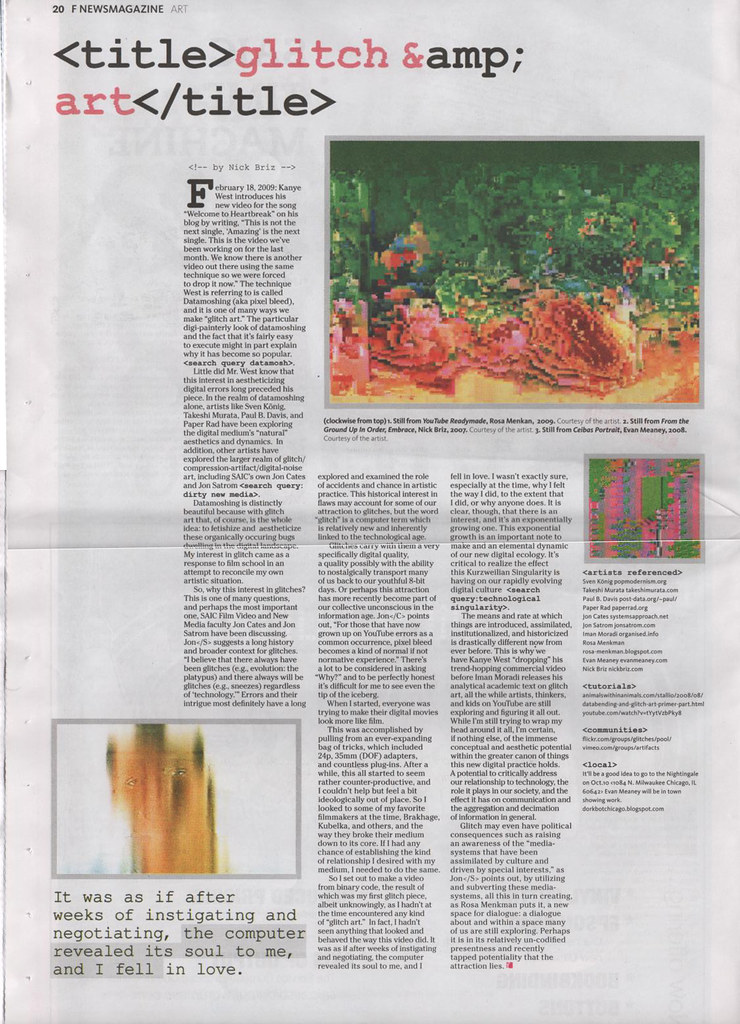 I am never sure if I should post these publications that I am somehow involved with, it seems a bit self aware or something. However, there is some good stuff, so here we go.. full on...
# In the begin of the summer Eva Sancho interviewed me for Nisimazine. The resulting piece is a small but good introduction to (some of) my work.
# Accidents in Celluloid and Pixel lost the Celluloid Remix competition at the Dutch Film Festival (NFF), but did get some feedback on a diploma signed by Dutch-Remix-Whizzkid-Guru Eboman: Starts annoying, becomes nauseating/rotten (free translation by me). Apparently in some Dutch slang (I am not familiar with) this means something positive. The comment works perfect for a glitch film anyway. hehe.
# Nick Briz is organizing periodical glitch events in and around Chicago. He used some of my films for the Eye and Ear Clinic (we need something like this in Amsterdam). He also wrote a piece for the student paper fnewsmagazine in which he used an image by me.
# It seems that Rafolio has finished his master thesis on digital decay. The pdf download is put together with a lot of effort and features some works by me (an honor to be part of that, really). It was especially nice to see that he picked the 404void.iq project (that I did in 2007) as one of his research subjects. I have actually been considering to do a 2009 sequal of the project, to see how much the Iraqi web has evolved in the last 2 years.
# Last Friday, Richard Rogers presented the IPbrowser at Impakt online festival in Utrecht. A project I worked on at DMI (together with oa. Alexander Galloway) and that later received support by Impakt.
# Kind of late and therefore less interesting: Radio Dada was part of the Intermerz program and screened at LEV Festival (Gijon, Spain) and TERRITORIOS DIGITALES 2009 (Sevilla, Spain). The video was also part of the Pixel Project collection. Performative Fail is part of the persuit of rejects project >> something will happen with this but I am not sure what.
# Second last and weirdest, I found a rather old interview of me and Goto80 at HAIP festival for Open Source Radio FRO in Ljubljana. Its awkward to listen too (at least for me). But now we got that out of the way too!
# Last but most interesting: I will be presenting my Glitch Studies Manifesto at Video Vortex, Brussels (20 November 2009) in the panel `System flaws and tactics`. The conference takes place in one of the spheres of the Atomium Funny how my latest glitch presentations take place in highly ordered places like the Hilton Hotel and a molecule structure.
I am never sure if I should post these publications that I am somehow involved with, it seems a bit self aware or something. However, there is some good stuff, so here we go.. full on...
# In the begin of the summer Eva Sancho interviewed me for Nisimazine. The resulting piece is a small but good introduction to (some of) my work.
# Accidents in Celluloid and Pixel lost the Celluloid Remix competition at the Dutch Film Festival (NFF), but did get some feedback on a diploma signed by Dutch-Remix-Whizzkid-Guru Eboman: Starts annoying, becomes nauseating/rotten (free translation by me). Apparently in some Dutch slang (I am not familiar with) this means something positive. The comment works perfect for a glitch film anyway. hehe.
# Nick Briz is organizing periodical glitch events in and around Chicago. He used some of my films for the Eye and Ear Clinic (we need something like this in Amsterdam). He also wrote a piece for the student paper fnewsmagazine in which he used an image by me.
# It seems that Rafolio has finished his master thesis on digital decay. The pdf download is put together with a lot of effort and features some works by me (an honor to be part of that, really). It was especially nice to see that he picked the 404void.iq project (that I did in 2007) as one of his research subjects. I have actually been considering to do a 2009 sequal of the project, to see how much the Iraqi web has evolved in the last 2 years.
# Last Friday, Richard Rogers presented the IPbrowser at Impakt online festival in Utrecht. A project I worked on at DMI (together with oa. Alexander Galloway) and that later received support by Impakt.
# Kind of late and therefore less interesting: Radio Dada was part of the Intermerz program and screened at LEV Festival (Gijon, Spain) and TERRITORIOS DIGITALES 2009 (Sevilla, Spain). The video was also part of the Pixel Project collection. Performative Fail is part of the persuit of rejects project >> something will happen with this but I am not sure what.
# Second last and weirdest, I found a rather old interview of me and Goto80 at HAIP festival for Open Source Radio FRO in Ljubljana. Its awkward to listen too (at least for me). But now we got that out of the way too!
# Last but most interesting: I will be presenting my Glitch Studies Manifesto at Video Vortex, Brussels (20 November 2009) in the panel `System flaws and tactics`. The conference takes place in one of the spheres of the Atomium Funny how my latest glitch presentations take place in highly ordered places like the Hilton Hotel and a molecule structure.
10/18/2009
Towards a conceptually endorsed synesthesia
To remove the barriers between sight and sound,
between the seen world and the heard world!
To bring about a unity and a harmonious
relationship between these two opposite spheres.
What an absorbing task!
The Greeks and Diderot, Wagner and Scriabin –
who has not dreamt of this ideal?
Is there anyone who has made no attempt
to realise this dream?
- Sergei Eisenstein [1]
The word synesthesia stems from the ancient Greek words σύν (syn), "together," and αἴσθησις (aisthēsis), ‘sensation’. Traditionally, (in the field of neuropsychology) synesthesia refers to an anomaly in the human brain (estimates vary between 1 in 20 and 1 in 20000) that results into the transference of an experience by one sense into another. This means that people with synesthesia can, involuntary, for instance ‘see’ sounds, ‘taste’ shapes, and so on.[2] Although synesthesia has been the subject of intense scientific investigation during many centuries, modern researchers have only recently rediscovered the concept. Today, both artists and scientists research synesthesia and the rules that “should be applied to transform sound into image, spatial movement into timbre or harmony into color."[3]
Because synesthesia is a highly subjective matter that only relies upon what is referred to as an anomaly, scientists and artists have not been able to trigger the effect purposefully. Consequently, in the arts the concept of synesthesia has evolved into a metaphor that relates to the act of crossing boundaries between different disciplines or fusing different media into one work.[4] An example of this is the integrated, ‘complete artwork’, which originates from 1849, when the German opera composer Richard Wagner first described his Gesamtkunstwerk. For Wagner, the individual arts of painting, dance, music and poetry had progressed as far as they could. He described that the future of the arts lied within the Gesamtkunstwerk, a synthesis of the poetic, visual, musical and dramatic arts. This total work of art would speak to all the senses at once and result in total immersion.[5]
A Color Box (Len Lye, 1935)
After 40 years of more or less successful attempts to record sound and moving image synchronised, it was Len Lye who finally set out to prove once and for all that music and video together could be part of the language of art. Lye is known to have stated: "All of a sudden it hit me. If there was such a thing as composing music, there could be such a thing as composing motion."[6]
Driven by a lack of money, Lye started off inventing new, controversial ways to create film without a camera. In 1935, he made the experimental movie A Colour Box. In this movie he color-painted and scratched the celluloid, connecting the visuals to the tunes of a Caribbean jazz piece. In 1937 A Colour Box was acquired by the General Post Office, who reissued it with the addition of a 'cheaper parcel post' message. The video continued its existence as a commercial.[7] Today, Len Lye is known as one of the pioneers of the music video genre.
Another telling example of cross modal practice finds its origin in the 1960s, when the artist Dick Higgins, a founder of the Fluxus movement, became well known for promoting interdisciplinary art practice. Following the example of Marcel Duchamp, Higgins calls for unusual combinations of genres. He popularises the term intermedia, which stands for media that investigate the border of multiple art practices. According to Higgins, in the realm of intermedia, any available object or experience can and should be incorporated into the artwork by mapping one structure onto another (in the digital sometimes referred to as transcoding). As a result, these intermedia artworks act in unpredictable ways, producing a new, more complex whole than its original parts.[8]
Variations V (John Cage and Higgins, 1965)
In 1965 John Cage answered to Higgins’ call for intermedia by composing the performance Variations V (with the help of David Tudor, Billy Klüver and others). As most of Cage’s works, the piece revolved around a central concept of chance. The play was generated on the spot, from thirty-five randomly equipped ‘remarks’ that outlined its structure, components, and methodology. The performance’ score was created within two different sound systems. The first sound system was dependent on directional photocells (light sensors) that were connected to an ‘orchestra’ of tape-recorders and record players. As the dancers moved around, they interrupted the light falling on the photocells, which switched the sound on and off. The second system used a series of antennas. When a dancer came within four feet of an antenna, this would initiate sound stemming from short-wave radios. In the background of the performance, screens would show a movie by Stan VanDerBeek and manipulated film footage from Nam June Paik.[9] Cage’s performance Variations V united technology, dance, video and sound, mapping their structures on top of each other, while leaving them dependent on chance. In doing so he created a noisy, multilayered synesthetic whole, that incorporated a cacophony sounds and visuals that stretched the limits of what was understood by the audience.
Advanced Beauty, Sample clip (flight404, 2007). (one the most beautiful audiovisual transcodings I know, yet missing some kind of conceptual relation)
10/01/2009
//ISEA 2009, Belfast //paper and powerpoints
ISEA is already a couple of weeks ago. I had my doubts about the conference as a whole but it was good to meet some new people. I presented this paper (its short, the max was officially 2500 words) about artifacts and also made some beautiful powerpoints (they asked for this explicitly so i only obey...)
Paper:"The use of artifacts as critical media aesthetics"
Subscribe to:
Posts (Atom)