
4/29/2010

interrupted by moments of peace


Cracklebox and telephone.
The Crackle box was "probably the first (1975) commercially available portable self-powered, alternative 'keyboard' analog audio synthesizer with inbuilt loudspeaker :)", developed and sold by Michel Waisvisz. During music hack day, I did the Steim workshop in which I made my own Crackle box.
The crackle box consists of an solid state op-amp chip that has its inputs and outputs wired in a circuit to facilitate the playing of that circuit with bodily contact. The sounds are partly random and partly controlled; they change according to humidity and skin resistance. This results in constantly changing tonalities, squeaks and structures of sounds and it makes it impossible to make a classical notation for the playing of the box - it really forces the artist to play intuitively.
I modded my version of the crackle box a little bit, by adding a light resistor and a switch (so I can still also play the original crackle box). Now, when I put the crackle box in a darker place, it sometimes starts singing by itself. I found that when I put my telephone close to its speaker, these sounds change into some wasted telephone drone - which are very different (almost in contrast) from the squeaky crackle sounds. This inspired me for some recordings.
The sound of the crackle box is not very present in the recording above, but some more crackle + telephone drone is due shortly.

4/25/2010

Dear mister compression


corrupt tango

<<>> Dear mr compression
I write a 1000 poems to you
Is this what they call progress?
Warmly yours,
the noxious angel of history

4/22/2010

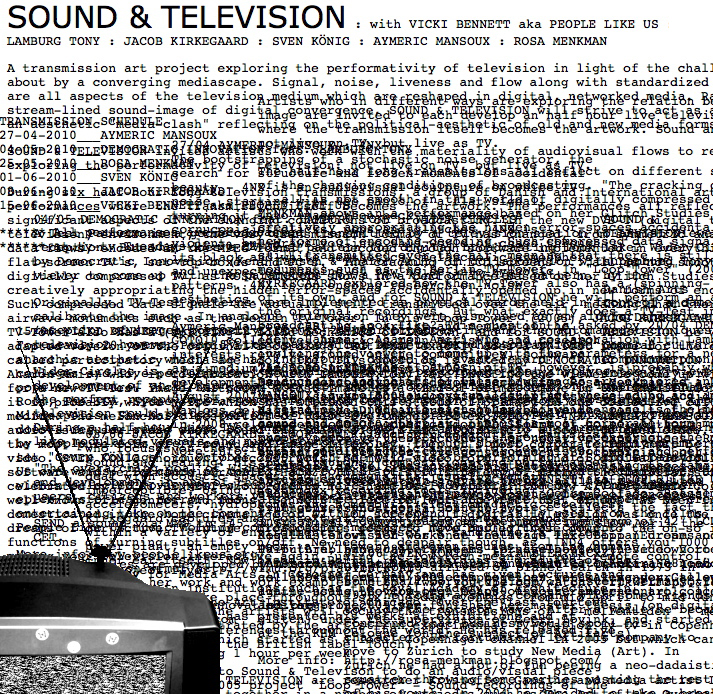
// Sound & Television, Denmark

Sound and television
Tuesday 25/05, 21.30-22.00: Audio visual television performance within the program "Sound and Television". On Danish nationwide digital television on the regional channels. Copenhagen: Kanal Hovedstaden. Fyn: TV Fyn. Midtvest: TV Midtvest. Bornholm: Kanal Bornholm. Nord: Kanal Nord. Syd: Kanal Syd. Øst: Kanal Øst. Østjylland: Kanal Østjylland.

"As a Transmission Art series, Sound & Television invites artists who work with the materiality of audiovisual flows to realise performances exploring the performativity of television: not live on TV, but live as TV. During six half-hour long television transmissions, a group of Danish and International artists develop performances where the transmission itself becomes the artwork. The performances all reflect on different significant aspects of the changing conditions of broadcasting. In the new
DVB-T (digital terrestrial television) environment, the very transmission format of TV has changed, from symmetric analog to asymmetric data flows, encoded in the MPEG format and decoded through software implemented in everything from flat-screen TV's, set-top-boxes and PC's. "The cracking of LCD screens"...all is not smooth in this world of digitally compressed TV, as ROSA MENKMAN shows in a performance based on her Glitch Studies Manifesto, creatively appropriating the hidden error-spaces accidentally opened up in new forms of encoding-decoding."

27-04-2010___AYMERIC MANSOUX

04-05-2010___DEMOCRATIC INNOVATION feat. LAMBURG TONY

25-05-2010___ROSA MENKMAN

01-06-2010___SVEN KÖNIG

08-06-2010___JACOB KIRKEGAARD

15-06-2010___VICKI BENNETT aka PEOPLE LIKE US


|||I|I|I|I|I||II|I|||||I|I|I| I|I||II|I|||||I|I|I| I|I||II|I|||||I|I|I|I|I||II|I||||||I|I|I| I|I||II|I|||||I|I|I|I|I||II|I|||||I|

4/19/2010

glitches vs glitch art


This week I am giving a week long workshop on file formats and how to deliberately break them, to reveal and use their structures and to create new audio-visual forms out of them. Of course the question "what is a glitch" came up. How does the glitch (the accident), to which I refer a lot in the workshop, relate to this practice? I have written about the same question in the Glitch Studies Manifesto, but never posted my perspective on this problem directly on my blog. I think it is the right time to re-post the particular paragraphs from the manifesto here.

Glitch vs glitch art
The glitch is a wonderful experience of an interruption that shifts an object away from its ordinary form and discourse. For a moment I am shocked, lost and in awe, asking myself what this other utterance is, how was it created. Is it perhaps ...a glitch? But once I named it, the momentum -the glitch- is no more...

But somewhere within the destructed ruins of meaning hope exists; a triumphal sensation that there is something more than just devastation. The negative feelings make place for an intimate, personal experience of a machine (or program), a system showing its formations, inner workings and flaws. As a holistic celebration the glitch can reveal a new opportunity, a spark of creative energy that indicates that something new is about to be created.
The glitch has no solid form or state through time; it is often perceived as an unexpected and abnormal mode of operandi, a break from (one of) the many flows (of expectations) within a technological system. But as the understanding of a glitch changes when it is being named, so does the equilibrium of the (former) glitch itself: the original experience of a rupture moved passed its momentum and vanished into a realm of new conditions. The glitch has become something new and has become an ephemeral, personal experience.

Glitch art
As an artist, I find catharsis in disintegration, ruptures and cracks. I manipulate, bend and break any medium towards the point where it becomes something new. This is what I call glitch art. Even so, to me, the word ‘glitch’ in ‘glitch art’ means something slightly different than the term ‘glitch’.
The genre of glitch art moves like the weather; sometimes it evolves very slowly while at other times it can strike like lightning. The art works within this realm can be disturbing, provoking and horrifying. Beautifully dangerous, they can at once take all the tensions of other possible compositions away. These works stretch boundaries and generate novel modes; they break open previously sealed politics and force a catharsis of conventions, norms and believes.
Glitch art is often about relaying the membrane of the normal, to create a new protocol after shattering an earlier one. The perfect glitch shows how destruction can change into the creation of something original. Once the glitch is understood as an alternative way of representation or a new language, its tipping point has passed and the essence of its glitch-being is vanished. The glitch is no longer an art of rejection, but a shape or appearance that is recognized as a novel form (of art). Artists that work with glitch processes are therefore often hunting for the fragile equilibrium; they search for the point when a new form is born from the blazed ashes of its precursor.
Even so, glitch art is not always (or by everyone) experienced as an art of the momentum; many works have already passed their tipping point. This is because glitch art exists within different systems and can be perceived differently by the different actors within these systems (for instance the system of production and the system of reception). Not only the artist who creates the work of glitch art is responsible for the glitch. The 'foreign' input (wrongly encoded syntaxes that lead to forbidden leakages and data promiscuity), the hardware and the software (the 'channel' that shows functional? collisions) and the audience (who is in charge of the reception, the decoding) can also be responsible. All these actors are positioned within different (but sometimes overlapping) flows in which the final product can be described or recognized as glitch art. This is why an intended error can still be called glitch art and why glitch art is not always just a personal experience of shock, but also (as a genre) a metaphor for a way of expression, that depends on multiple actors.
Over time some of the glitches I made developed into personal archetypes; I feel that they have become ideal examples or models of my work. Moreover, some of the techniques I (and others) used became easily reproducible for other people, either because I explained my working process, or sometimes because of the development of a software or plugin that automatically simulated or recreated a glitching method (that then became something close to an ‘effect’). I noticed that these kinds of normalizations or standardizations happen very often. Therefore, to me, the popularization and cultivation of the avant-garde of mishaps has become predestined and unavoidable.
The procedural essence of glitch art is opposed to conservation; the shocking experience, perception and understanding of what a glitch is at one point in time, cannot be preserved to a future time. The beautiful creation of a glitch is uncanny and sublime; the artist tries to catch something that is the result of an uncertain balance, a shifting, un-catchable, unrealized utopia connected to randomness and idyllic disintegrations. The essence of glitch art is therefore best understood as a history of movement and as an attitude of destructive generativity; it is the procedural art of non con-formative, ambiguous reformations.
Nevertheless, some artists do not focus on the procedural entity of the glitch. They skip the process of creation-by-destruction and focus directly on the creation of a formally new design, either by creating a final product or by developing a new way to recreate the latest archetype. This can for instance result into a plug-in, a filter or a whole new 'glitching software'.
This form of 'conservative glitch art' focuses more on design and end products then on the procedural breaking of flows and politics. There is an obvious critique: to design a glitch means to domesticate it. When the glitch becomes domesticated, controlled by a tool, or technology (a human craft) it has lost its enchantment and has become predictable. It is no longer a break from a flow within a technology, or a method to open up the political discourse, but instead a cultivation. For many actors it is no longer a glitch, but a filter that consists of a preset and/or a default: what was once understood as a glitch has now become a new commodity.
But for some, mostly the audience on the receptive end, these designed errors are still experienced as the breaks of a flow and can therefore righteously be called glitches. They don’t know that these works are constructed via the use of a filter. Works from the genre ‘glitch art’ thus consist as an assemblage of perceptions and the understanding by multiple actors. Therefore, the products of these new filters that come to existence after (or without) the momentum of a glitch cannot be excluded from the realm of glitch art.
Even so, the utopian fantasy of 'technological democracy' or 'freedom' that glitch art is often connected to, has little to do with the colonialism of these glitch art designs and glitch filters. If there is such a thing as technological freedom, this can only be found within the procedural momentum of glitch art, -when a glitch is just about to relay a protocol.

[this text is part of the glitch manifesto and is thus a my personal reflection on the glitch vs glitch art. I published it here also because it is a very important primer to understand my research that I post on this website]

̱͇̒

4/17/2010

Alternative composing in chipmusic


65 76 65 72 79 74 68 69 6e 67 20 69 73 20 6d 75 72 64 65 72 65 64 20 62 79 20 74 68 65 20 68 61 6e 64 73 20 6f 66 20 74 69 6d 65

Video and sound by me. Created by editing dv compression in an hex editor.

Last Wednesday (April the
14th) I was invited to give a talk at Steim about alternative composing in chipmusic. First this made me feel a bit weary. Not only because I am not so much a musician but a visualist (sometimes with 8bit and sometimes with 67 6c 69 74 63 68 bits). So I was kind of out of my comfort zone. Secondly, saying something like "I am going to talk about chipmusic" sounds a bit like "I am going to talk about guitar music"; its just very general. Moreover, I am not a big chiptune fan at all. To me, most of this music sounds very similar - especially most of the music that uses the standard hardware+trackers. However, there is also a couple of musicians that I do like to follow and that I do think make very special music. So this talk had all the potential to become very bad and I really had to rethink what I do like about chipmusic.
There are a couple of things I like about this community (or niche/s). But to make it more specific and personal, I decided to focus on what uses of instruments, a material of chipmusic, inspires me the most in my own work. What I really enjoy about this community is the way some of the musicians use their material, in new, pushing ways (both soft and hardware). This is why I came up with the idea to do a little talk about alternative composing in the chip-scene - composers that inspire me to rethink how to use my technologies when I make video.


This is the list of artists I chose
Paul Slocum (Epson LQ-500 - EPROM chip music)
Sega Death (Sega Genesis cartridge elimination)
Goto80 (Commodore 64, defmon software)
little-scale (SEGA Master System, Ym2413 Fm chip and Ableton Live / Max/MSP)

Gijs Gieskes (Sega Nomad, Atmega168 chip)

Tristan Perich (1bit chip music)

My chip mix can be downloaded here
(txt file is to document what I like about the specific songs/artists I chose).

And a special thanks to Julian (c-men) and Sebastian (little-scale) for their help/sharing of thoughts!


4/14/2010

//Critical Glitch Artware / Notacon / Blockparty

critical artwareCriticalartware, which used to be an media art hystories research & development lab is now an artware demo crew from Chicago. They will present the new category of glitch-art demos and videos at this years Blockparty and Notacon 2010 (April 15th), for which they invited four of my videos. Please take a look at their site, because it is interesting and somewhat of a javascript-demo itself, changing every time you load it.

Some reflections on the entrance of a new 'niche' in the demoscene
As I have had the luck and the pleasure of following Anders Carlssons high quality research on the demoscene closely, I have had the opportunity to pick up on some of the long history of this scene. This is why I think it is important to underline the recent development of new public, participants and even new demo groups coming from different subcultures (like gaming, 8bitpeoples - chiptunes and now also glitch art interests) into the demoscene.
While it seems that many of the old 'elite' or 'old school' demoscene people are still 'stuck' in their own bounded culture (and also keep describing and pursuing it as such), outsider cultures have been finding an entrance into this culture (on both pcs and old school machines).
While for the old school / elite demosceners, demos are still often about trying to squeeze as much out of the computers live-processing capabilities as possible, many other (newer) demoscene groups and movements are focusing on other things; like extravagant shader graphicxs, decadently pixeled designs and (in the case of CGA) the haughty results of hypertrophy in hard and software.
The new kids, of which I am one, visit not only the bigger parties like blockparty but also smaller ones, like LCP and bring their own new perspectives and traditions into this what used to be a bounded scene. As a result, I think that the demoscene has become much more of a fluid, open culture. The big difference between the elite niches and the newer niches, are their perspectives on what the scene is about.
I wonder if theorists can still subscribe to the idea of the demoscene as a coherent, bounded culture with multiple facets (reflected in for instance the different compos), is there still one demoscene? Or did modern culture caught up with the demoscene a while ago and is the scene now slowly transforms it into a rhizomatic, fluid and open cultural category consisting of multiple prosumer niches.

4/13/2010

//Hotpot Lab #4: Niche Music Talk

bird of paradiseI was asked to present a selection of music at Steim regarding chipmusic and the demoscene (as an 'expert listener', hehe). If you don't want to miss and learn about the opinion of my discorded, scruffy ear lids come tomorrow and suffer pleasurably.
Afterwards I will make my selection of Niche music available here or somewhere else.
Wednesday, April 14 2010, 20:30.

4/06/2010

//Angel of history - Shattered horizons :: in Budapest with Failotron

shattered horizons4476983940_f5d15f5131_bAron / failotronFriday 7 pm, 9th of April, at Videospace, Budapest the exhibition "Processes" will open. This exhibition will include my video Radio Dada.
Failotron and I will do a short performance which will hopefully incorporate the "Angel of history" video, which is full on in the making.

4/01/2010

//Vanishing Lines

By Doung Jahangeer and Rosa Menkman.
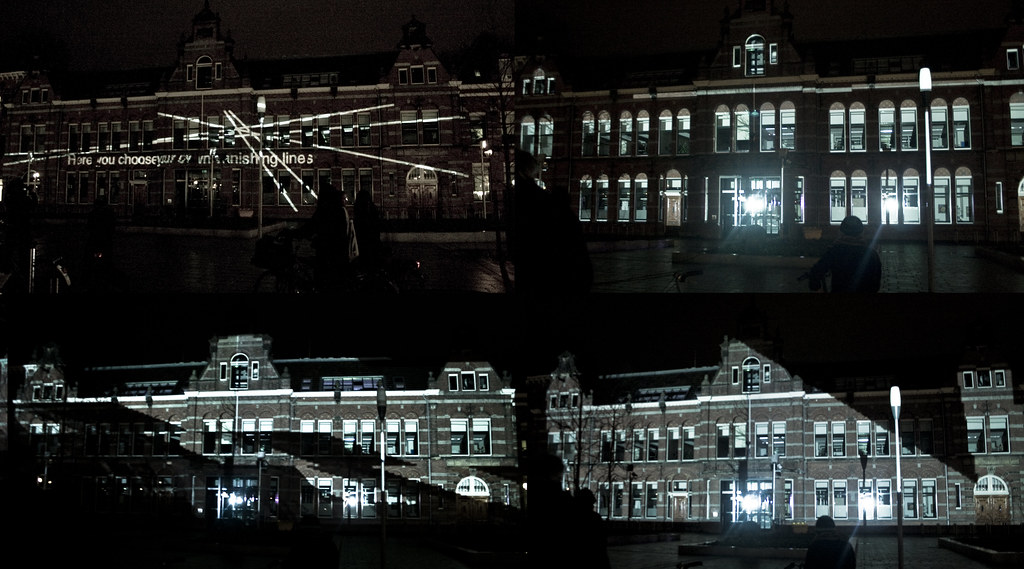
Vanishing linesSite specific projection for the Stadsdeelkantoor, Westerpark, Amsterdam. Made during The Media City workshop at NIMK. Projected on the 2nd of April.
During The workshop, I met Doung
Jahangeer who lives and works in South Africa. His work is based on the cracks within (social) architectures, that allow the explorer to define and create new, other space.
In his presentation on Tuesday (23th of March) Doung presented his manifesto on architecturewithoutwalls (to be published), which had a lot of similarities with both my glitch studies manifesto and in-between manifesto. We explored these connections within the small text we wrote that formed the basis of our collaborative projected
"Vanishing Lines".
Vanishing Lines documentation

Vanishing Lines // Vanishing Points
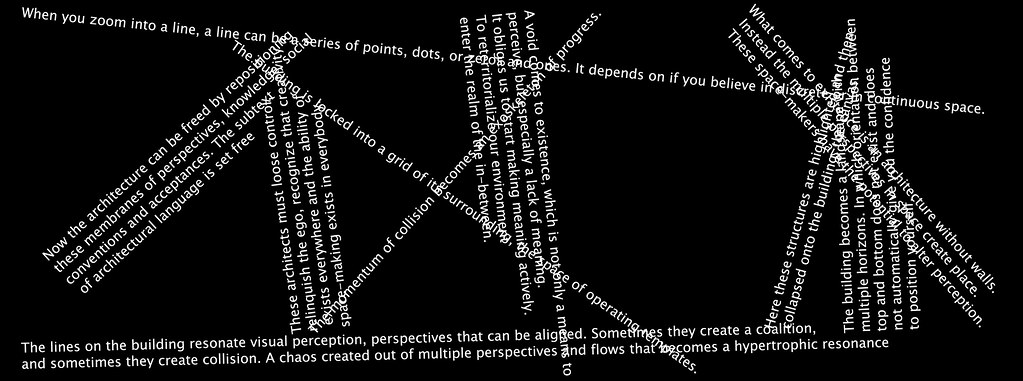
The creation of space as a concept as well as a practice, cannot be defined within entities, but is defined between different entities, and their perspectives. The architecture of space is in-between, and always multi-layered.
In Vanishing Lines, the building is locked into a grid of its surrounding; the space of operating templates, the grid of the Westerpark. These structures are highlighted and then collapsed onto the building, the canvas.
The lines on the building resonate visual perception; different perspectives are being aligned. Sometimes they create a coalition, and sometimes they create collision. A construction created out of multiple perspectives that evolve into a hypertrophic resonance.
The architecture can be freed by repositioning the membranes of perspectives. In this instance, the subtext of architectural language is set free. What comes to existence is an architecture without walls.
In this architecture without walls, the multiple perspectives in space create place. These space-makers provide the potential to alter perception.
Architects must learn to loose control and recognize that creativity exists everywhere: because the ability of space-making exists in everybody.
In Vanishing Lines, for a moment, the building has become a landscape with multiple horizons, in which orientation between top and bottom does not exist.
The landscape is artificial. It exists in-between the dichotomy of the real but totally constructed horizon and a digital fantasy horizon. The architecture does not automatically give the viewer the confidence to position himself, but instead, the viewer has to reterritorialize his environment and in so doing, he is forced to choose his own vanishing lines.

░░░░░░░░░░░░░░░░░
░░░░░░░░░░░░░░░░░░░░░░░░░░░░░░░░░░░░░░░░░░░░░░░░░░░░░░░

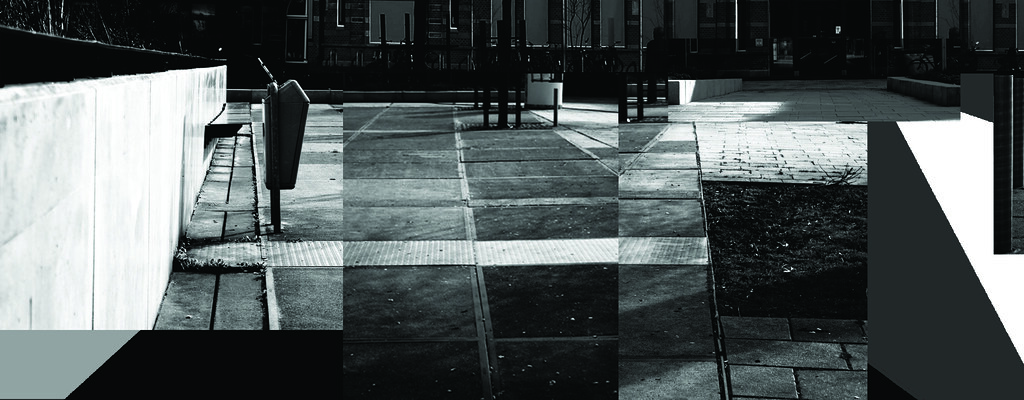
After writing the basic text we went to the site to make photos and draw up the grid (virtual and real) that exist around the building.
Vanishing Lines documentationVanishing Lines documentation
We drew lines on the grid, that formed a new architectural shape, and placed parts of the text on top of this shape. With the help of some digital glitches, we collapsed this shape, which formed a new space construction.
The first movie I made was high contrasted red and black, but it did not print nicely on the brick building :: the red light did not reflect at all, and the text was not readable because of the 3d surface. In fact in further testing it became clear that only few colors reflected and only hard shaped edges and abstract images were recognizable - the photos were unfortunately unusable. This is why I changed the pace and build up of the video - more basic, simple with contrasts in colors and speed.
Vanishing Lines documentationVanishing Lines documentation
the result is a very basic video, that did work well on the building. the soundtrack based on Goto80s MCMCMC made it perfect. The
video is centered around the idea that we can choose and create our own vanishing lines.
Video documentation will be added soon.

(Music by Goto80: parts of MCMCMC)

░░░░░░░░░░░░░░░░░░░░░░░░░░░░░░░░░░░░░░░░░░░░░░░░░░░░░░░░░░░░░░░░░░░░░░░░

Still born


Music by Extraboy.
Unfinished First Born remake, RIP Oaktabarn.