2/28/2011

//Filtering Failure Beer Release

Scanned Filtering Failure // Glitch Studies Manifesto // Gogbot 2011 beer bottle
Planetart asked me to design the label of the Eurotrash beer that is specially brewn by artist Arno Coenen (around 7%) for the opening of the Filtering Failure exhibition. Almost all the beers of the 10 boxes ordered were finished the night of the opening, but there are still a few still left in the Planetart exhibition, so feel free to drop by and .. have a beer!

The Low Times of Hi-Fi :: 3,5 inch floppy release ...

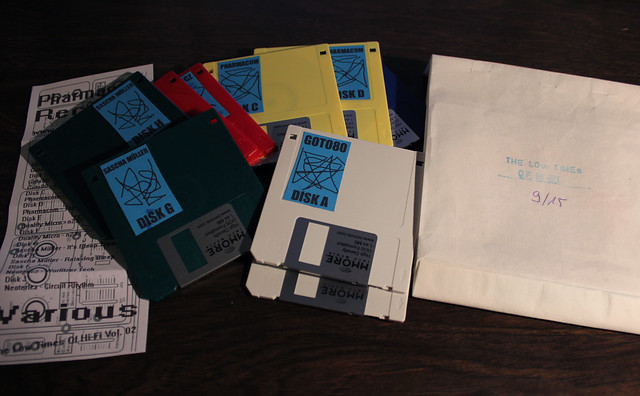
The Low Times of Hi-FiAlmost a year ago I was asked to create a video for Pharmacon Records floppy release "The Low Times of Hi-Fi". Today I got this package in the mail - which was kind of serendipitous&unexpected (it has been such a long time).... The release consists of 10 3 1/2-inch floppy disks, with music from different artists and one floppy with a music video by me and Goto80.  

For the creation of the video used the most extreme compression I could make (less then 5KBS), compressing the in total 3:20 min video to less then 1MB. After that, Goto80 composed some compression-mangled music  that in the end resulted into a complete music video of 1MB in size.

Pharmacon records"The Low Times of Hi-Fi" - Pharmacon records
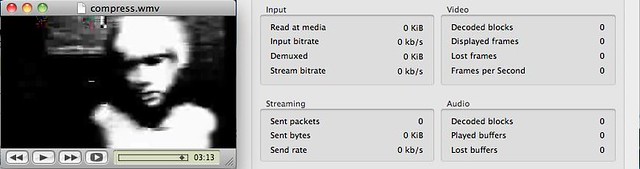
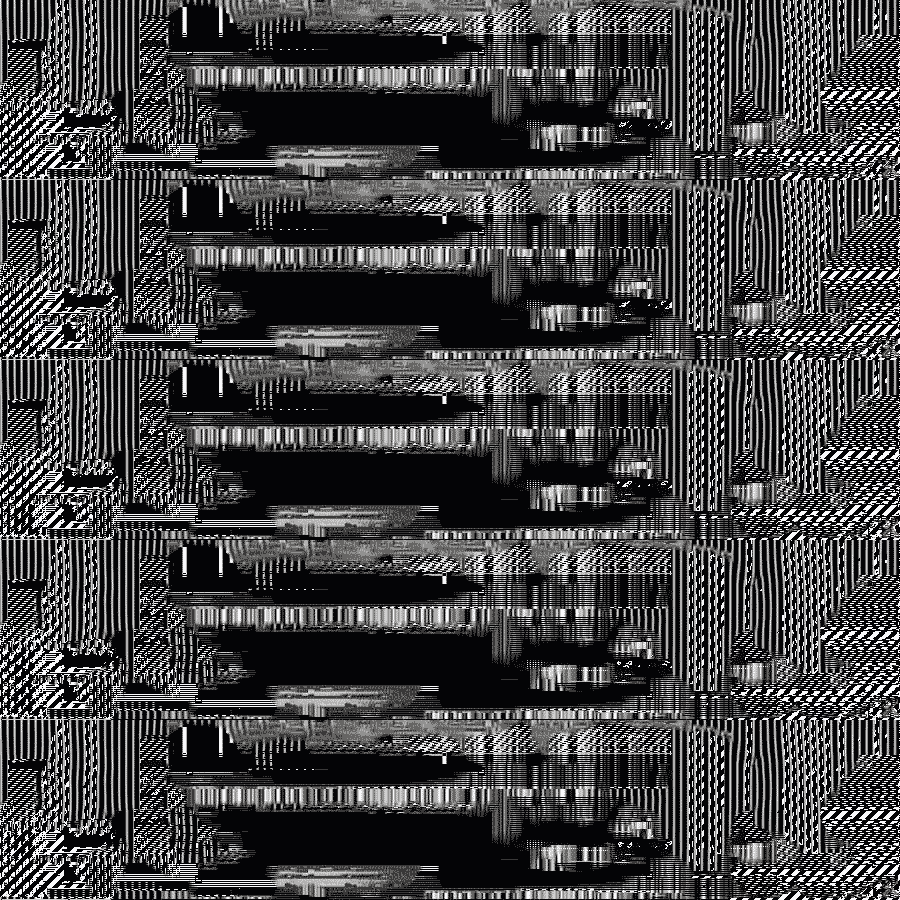
The video is a re-work of "Dear mr Compression" (which was a love poem to mr. compression, celebrating all beautiful quirks and imperfections). This version however, is extremely compressed and black and white - mr compression zooms so unforgivingly much into the imperfections of the registered image that what is seen has become kind of ..  -,, nothing.. (at least VLC just refuses to register for some kind of silly reason.)

2/17/2011

‘Acceleration vs. Compression’, 2011 at Or-Bits.com

Adventures in the Tulgey Wood
Marialaura Ghidini asked me to contribute to her Acceleration Show on Or-bits.com. I really like the theme and I wish I would have had more time to write or make a more extensive work for her. The online show opened last weekend and has some nice spocky references. Here are some more details about my work, for the work itself and the rest of the exhibition you should check out the or-bits website.

‘Acceleration vs. Compression’, 2011
I aimed to make a short audiovisual work, but once I had finished it, I did not feel satisfied; I think that it was because the sounds I created for the animation did not feel right.
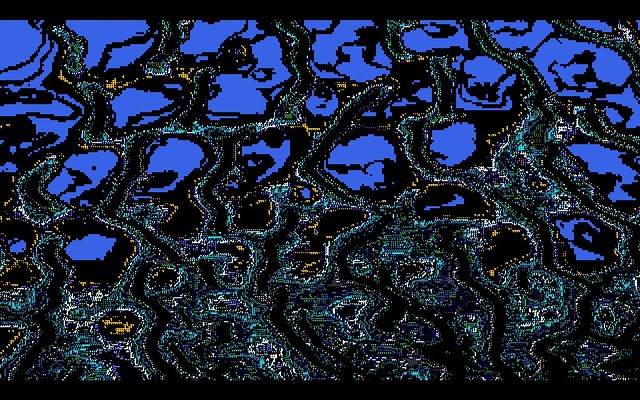
The original video was compressed as an AVI Cinepak, which is an obsolete compression since its colour palette is not being recognised anymore – this is why the colors look so psychedelic –.
I decided to delete the sound and to shorten the piece into an animated GIF.
The compression of the GIF is an old fashioned compression that cuts out a lot of data, in order to be able to be downloaded faster – it is a “save for the web” setting –-.
The GIF will accelerate when it is loading.
To me this is a form of technological poetry, visualizing the story about deletion by compressions, in order accelerate. 
2/16/2011

I don't know where I'm going but I want to be there

I don't know where I'm going but I want to be there
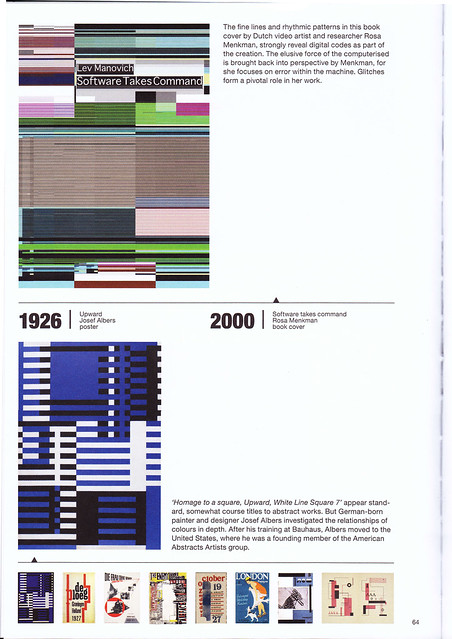
My book cover for Lev Manovich' Software Takes Command (2008) is featured in the book "I don't know where I'm going but I want to be there // The Expanding Field of Graphic Design 1900-2020" by BIS publishers. (2010) (right beside Josef Albers!)

ISBN: 978-90-6369-257-5
Notes: Edited by Sophie Krier, Marjolijn Ruyg and Minke Kampman.

Format: paperback
Dimensions: 25 x 17.5 cm
Pages: 168

2/15/2011

Filtering Failure exhibition catalogue


The catalogue can be downloaded here ###########
#################################################### 

▓▓Filtering Failure ▓▓▒▒▒▒ ▒▒ ▒▒ ░ ░ ░
In a culture that is continuously accelerating, filters have become a primal commodity. We use them both to open and to close ourselves to or from any kind of possible information. Filters are ubiquitous. However, we only realize their presence when we lack them or when they fail our expectations. On the other hand, modern digital cultures are inseparable from keywords like functionality, s...moothness, order and progress. Interaction designers, programmers and interface developers all work together to understand and execute these mantras. But to really understand these keywords, they have to be defined in relation to what they are not. A successful product designer does not design for the average customer, but instead for the marginal, extreme customer; because when taking the margins as the rule, the middle will take care of itself. ! This is why studying the qualities of disfunction, irregularities, breaks, disorder, damage or even demolition are as important in the development of a new technological product as the researching of its perfect flows and this is also one of the reasons why I think it is important to study failure. The concepts of perfection and failure are a tradeoff of each other. If we want to understand and pursue perfection - we can find this in the pursuit of failure.

The exhibition Filtering Failure investigates (the connections between) the procedural terms ‘filtering’ and ‘failure’ and how in (lo-fi) digital arts these terms are being re-invented and re-used. The exhibition asks how Filtering and Failure co-exist; and how these processes influence each other.
The exhibition includes new and older works from the avant-garde of glitch artists. These works show the filtering of failure as a generative process, but also to unfold a genre that includes many the different envelopes of personal ways of dealing with failure.

Filering Failure is curated by Julian van Aalderen and Rosa Menkman.

Participating artists:
Paul Davis (US/UK)
Benjamin Gaulon (IR/FR)
Gijs Gieskes (NL)
Jodi (NL/BE)
Karl Klomp (NL)
no-carrier (US)
Notendo (US)
Nullsleep (US)
Jon Satrom (US)
Videogramo (ES)

Filtering failure is an initiative of PLANETART and GOGBOT in collaboration with Rosa Menkman and Julian van Aalderen

Powered by gem. Enschede, Blacklabel Records & Eurotrash Brewery.
Opening: 25th of Februari with live visuals by vj the c-men (Enschede): Julian van Aalderen, Sjors Trimbach & Edwin van Aalderen
The exhibition is open from monday to fridays between 14:00-17:00 (28th of Februari to the 1st of April 2011).
www.planetart.nl

#################################################### 

▓▓Filtering Failure ▓▓▒▒▒▒ ▒▒ ▒▒ ░ ░ ░
De tentoonstelling Filtering Failure opent vrijdag 25 februari om 20:00 uur in Planetart, Volkskrantgebouw, Wibautstraat 150, Amsterdam.

Filtering en Failure (filteren en falen) zijn actuele begrippen, niet alleen in de kunst en cultuur, maar ook binnen de economie, de communicatie, geneeskunde en vele andere specialisaties en niches in de samenleving. Filteren betekent het doorlaten van bijvoorbeeld informatie, doorgaans om een gewenst residu over te houden. Falen refereert aan het niet bereiken van een dergelijk gewenst resultaat.
Filteren is een primaire voorwaarde binnen een zich steeds versnellende cultuur; filters helpen bijvoorbeeld bij het organiseren van informatie of kunnen worden ingezet in de strijd tegen 'information overload'. Filters berusten zich vaak op conventies. Hierdoor zijn we ons vaak bewust van het bestaan van een filter op het moment dat ze ontbreekt, of wanneer ze niet aan onze wensen of verwachtingen voldoet.
Het begrip falen bestaat in nauw verband met wat het juist niet is; falen (of mislukken) en succes (of perfectie) zijn twee kanten van dezelfde medaille. Digitale cultuur is onlosmakelijk verbonden met begrippen als perfectie, orde en vooruitgang. Programmeurs, interaction en interface designers werken samen om deze mantras vorm te geven. Zij begrijpen dat binnen het ontwikkelings-proces van een nieuw product, het bestuderen van de kwaliteiten van disfunctie, gebrekkigheid, wanorde en falen net zo hard nodig is, als het onderzoek naar hoe datzelfde product kan worden geperfectioneerd. Perfectie kan beter begrepen worden door een onderzoek naar mislukking. Dit is waarom het belangrijk is om mislukkingen te bestuderen.
De tentoonstelling Filtering Failure bevat nieuw en ouder werk van kunstenaars die de begrippen filtering en failure als uitgangspunt nemen voor het ontwikkelingen van nieuw werk. Sommigen gebruiken het filteren van mislukking bijvoorbeeld als een generatief proces. Anderen onderzoeken filters in relatie tot de commodificatie van effecten, of juist als onderdeel van het proces van veroudering en het in onbruik raken van bepaalde hard- en softwares. Op deze manier probeert Filtering Failure het discours van omgaan met mislukking te omvatten en onderzoekt het de werking van de relaties tussen de begrippen ‘filtering’ en ‘failure’.

Filering Failiure is gecureerd door Julian van Aalderen en Rosa Menkman.

Deelnemende kunstenaars:
Paul Davis (US/UK)
Benjamin Gaulon (IR/FR)
Gijs Gieskes (NL)
Jodi (NL/BE)
Karl Klomp (NL)
no-carrier (US)
Notendo (US)
Nullsleep (US)
Jon Satrom (US)
Videogramo (ES)

Filtering Failure is een initiatief van PLANETART en GOGBOT in samenwerking met Rosa Menkman en Julian van Aalderen.
Powered door gem. Enschede, BlackLabel Records & Eurotrash Brewery
Opening: 25 Februari met live visuals verzorgd door vj the c-men (Enschede): Julian van Aalderen, Sjors Trimbach & Edwin van Aalderen

De tentoonstelling is open van maandag tot vrijdag van 14:00-17:00 (van 28 februari tot en met 1 april 2011).
www.planetart.nl


####################################################

2/09/2011

//Filtering Failure Exhibition; opening 25/2 (until 1/4), Planetart, Amsterdam.

Filtering Failure - Exhibition in Amsterdam 25/2/2011
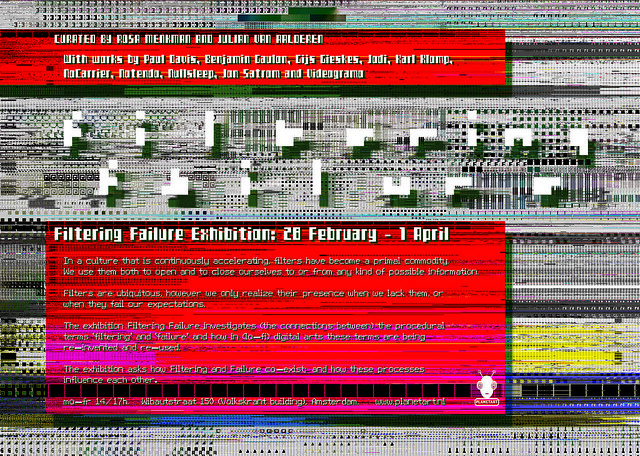
In two weeks the exhibition Filtering Failure (25-2 until 1-4) will open here, in Amsterdam. The exhibition is curated by me and Julian (C-Men) and reflects on the relations between the processes of  ering and Failure.  
    ------------------------------------------
In a culture that is continuously accelerating, filters have become a primal commodity. We use them both to open and to close ourselves to or from any kind of possible information.        
Filters are ubiquitous, however we only realize their presence when we lack them, or when they fail our expectations.

The exhibition Filtering Failure investigates (the connections between) these procedural terms ‘filtering’ and ‘failure’ and how in (lo-fi) digital arts these terms are being re-invented and re-used.
 
We can set at least 3 different ways of Filtering Failure apart;
There is the filtering of failure as a garbage or redundant residue (the necessary filtering of all the information we encounter, all the time). Here the focus lies on the everything that has not been filtered, which is the information that will be used.  
Secondly, the title can be interpreted as the failure of filtering, which will result in information overload ("It's Not Information Overload. It's Filter Failure" - Clay Shirky).     
Lastly, Filtering Failure can refer to the process of filtering failure as a wanted result. In the exhibition we start from this latter perspective, while trying to show a tension between the two first forms.

                  Failure can r ef      er
                  Failure ca n ref      er
The exhibition asks how Filtering and Failure co-exist; and how these processes influence each other. I hope to see you there, at the opening, or later in the month!

Mo-Fr 14/17h. Wibautstraat 150 (Volkskrant building), Amsterdam. www.planetart.nl

2/08/2011

Collapse of PAL at Transmediale [a review by Jussi Parikka]


------------------------------------------------------------ ------------------------------------------------------------
----------------  ----------------------------------
photos by Jonathan Gröger and David Szauder (thank you!)
----------------------------------------------------
--------------------------------------------------------
------------------------------------------------------------

A couple of days back I performed the Collapse of PAL at the Transmediale. I edited a lot for this version to make it fit with the theme (:Live). It was full, it went well and today I was made aware of this very nice review by Jussi Parikka:

For me, last year it was Gebhard Sengmuller’s A Parallel Image, and this year Rosa Menkman’s The Collapse of PAL: the media archaeological highlight of Transmediale. Menkman’s performance dealt with obsolescence, death of media, and what is most interesting, media archaeology of signals and signal formats. Instead of the focus on devices, even if at times lost and outside mainstream, we are seeing new perspectives that take in their focus components, processes and such “minor elements” of media history.

The performance was a two-screen installation with Menkman using various audio and video sources and the signal twisted, modulated, bent. She combined the signal with a Cracklebox, a Eurosignal (a zombie-signal), Morse code and an old Casio keyboard among other things (info from the Transmediale 2011 programme book). The screens were filled with electronic signal landscapes, of waveforms and at times recognizable Gestalts. The angel from future, a Benjaminian figure of critique of progress, was the protagonist through whose mouth the Collapse of PAL painted a history of the PAL signal as loser to for example the DVB signal. The terms such as losers of history, history excavated in midst of rubbles, storm of progress which works to hide the multiplicity in history all point directly to Benjamin’s famous On the Concept of History text.

Despite the fact that I loved the performance, I also sensed the danger of nostalgia in this strong defensive reaction of history of losers – which was framed through an idea of progress as the force that blindly abandons all that it considers inefficient. A critique of rationalism and progress, the other aspects of the media archaeological gesture of the dialectics between losers and emerging media is not grounded enough. To what extent are we in danger of celebrating past media just for the sake of our emotional attachment to them as childhood memories and part of the collective media memories that are now in danger of being lost with new signal solutions and media environments? How to differentiate the media archaeological critique from nostalgia, and hence from a crucial part of the late capitalist consumer media sphere that Fredric Jameson pointed out as one crucial affective feature of contemporary culture?