10/20/2010

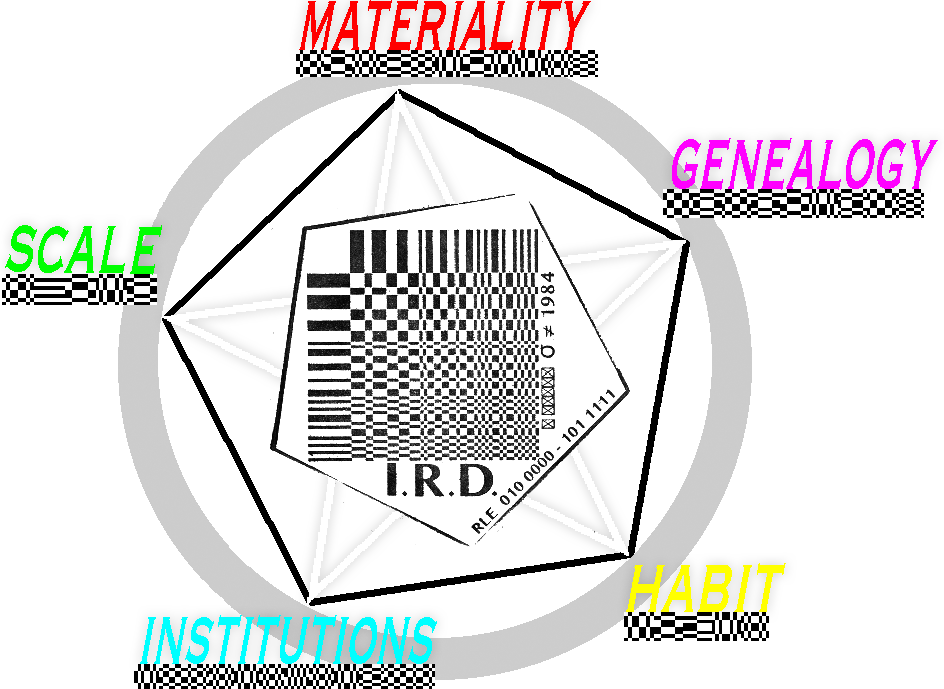
//V★rn⧓cul⧓r ✦f Fil★ Form⧓ts ⧓t th★ GLI.TC/H G⧓ll★ry sh✦w


Rosa Menkman [http://rosa-menkman.blogspot.com/]
=
The Vernacular of File Formats was part of the GLI.TC/H gallery show (which was an experiment, how to exhibit a PDF?).
Here are some videos of the opening (taken at the beginning and the ending of the evening) + a photo of a guest enjoying my pdf in the exhibition.

10/18/2010

//Glitchs N✦t Dead! --->> New D⧓tes! ★ ★ ★ ★ ★

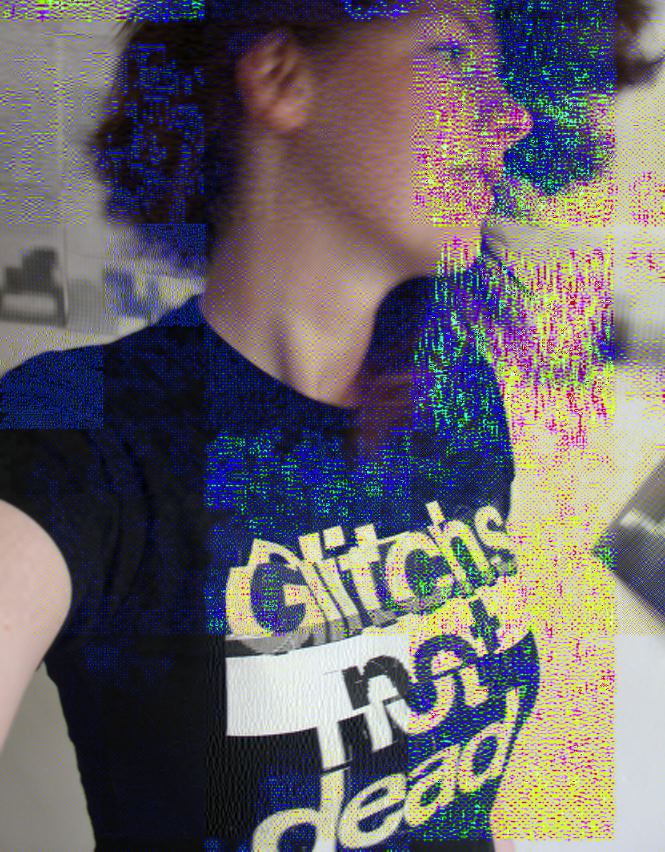
GLitchs not dead
My new GLITCHs NOT DEAD t-shirt designed by UCNV, which I got as a present-response after writing this in the Vernacular of File Formats:
"…I am waiting for the first "Glitchs not dead" hoodie in H&M. And because fans are as bad as the ignorant, for the sake of being bad, I will definitely wear the hoodie."
Viva Helvetiva Punks! ( : I think Curt Cloninger should write some more about this in his GltchLnguistx 2.0 : )

///////////////////////////////////////////////////////////////////////////

So... Glitchs Not Dead >>> time for some really huge new things in the agenda (and some things I had no time to post about that are now in the past)! I hope to see you in Łódź, Berlin or Sao Paolo!

09-11->22-12-'10 – Residency at labMIS. working on the Glitch Studies Manifesto - movie. Sao Paolo, Br.
5-11->7-11-'10 – TBA @ Persuit of Failure Symposium in Berlin, De.
2->7-11-'10 – Screening @ Share Festival Sm_Art Mistakes in Torino, It.
30-10->!! – Solo exhibition Galeria NT, Łódź, PL.
15-10-'10 – Impakt Festival (w/ oa Gijs Gieskes) Small interview + screening of Radio Dada and Demolish the eerie ▼oid.
30->10-10-'10 – screening of Collapse of PAL @ e-fagia.

//////////////////////////////////////////////////////////////////
/////////////////////////////////////////////////////////////////////

GLI.TC/H: /* Stallio! */ VS /* Vade && Rosa Menkman */


During the last performance-night of GLI.TC/H, Vade and I decided to do some impromptu visuals for Stallio! ... 
Vade used a dirty mixer (think Karl Klomp) and an analog tv scanner to mix my video and analog-data-surround-video with some of his patches.

Shouts outs went to Angelina Jolie... and Mary Ann and Paris who did visuals the same night in NYC, for the Hackers The Movie 15th Anniversary party. 

Thanks to Evan Meaney for filming!
and a shout out to /* Hellocatfood */ for no apparent reason - accept for beer, buttons and cleaning.


///////////////////////////////////////////////////////////////////////////
///////////////////////////////////////////////////////////////////////////

10/17/2010

Requiem for The Planes of Phosphor + a Love Story remix!


Part 3 of The Collapse of PAL (rendered version)
Music and video by Rosa Menkman

I used different glitches and compressions to get to the sounds and the music.

The beginning 10 sec. is a sample Daniel Wilson used in our last music video, "Digital Ate the Cassette Tape".

///////////////////////////////////////////////////////////////////////////
/////////////////////////////////////////////////////////////////////////// 

Remix of Requiem for The Planes of Phosphor by Rosa Menkman, Pixelnoizz and Russian Disco by Low Bob and Mamiko Motto during Satta Outside festival 2010, in Lithuania.
 
///////////////////////////////////////////////////////////////////////////
///////////////////////////////////////////////////////////////////////////  

10/16/2010

GLI.TC/H review at Rhizome ≡ ≡ Code Eroded

 ∆ Gli.tc/h ∆ 

Sildeshow from the gallery-evening
       
Tom McCormack wrote a lengthy, very nice review // break down of GLI.TC/H, the festival/conference/exhibition/happening that I co-curated/organized, that took place in Chicago 2 weeks ago. I will repost it here.


Glitch1.jpg
GLI.TC/H gallery opening
(Photo by Rosa Menkman)


In the inverted world of glitch art, functionality is just a sterile enclosure of creative space and degradation an agent of renewal.
Such was the spirit in the air at GLI.TC/H, a five-day conference in Chicago organized by Nick Briz, Evan Meaney, Rosa Menkman and Jon Satrom that included workshops, lectures, performances, installations and screenings. Intuitively, most people involved with new media know what glitch art is – it’s art that tweaks technology and causes either hardware or software to sputter, fail, misfire or otherwise wig out. Narrowing in on a more precise definition can be perilous, though. Purists would insist on a distinction between art that uses actual malfunctions and art that imitates malfunctions, but the organizers of GLI.TC/H took a catholic approach to their programming.
A concern with the histories and pre-histories of glitch art pervaded the conference. In her lecture and presentation, Rosa Menkman offered an avenue for one possible genealogy, juxtaposing Len Lye’s A Colour Box(1937), a kinetic film consisting of scratched and hand-painted celluloid, Nam June Paik’s famous Magnet TV (1965), a television with a magnet placed on top to distort the signal, Cory Arcangel’s TH42PV60EH Plasma Screen Burn (2007), a plasma television with text burnt into it and Jodi’s Webcrash2800 %SCR2 (2009), which consists of cracked LCD monitors. As celluloid gave way to cathode ray tubes, which gave way to plasma screens and liquid crystal displays, every mutation seems to have been accompanied by a desire to break the screen, to draw out some of its essential properties; properties which either weren’t reckoned with by its makers or were purposefully hidden.

Joan Heemskerk and Dirk Paesmans, who work under the name Jodi, are clearly spiritual ancestors of modern data corrupters. In addition to being Skyped in for the closing lecture and discussion, Jodi’s piece Untitled Game (1996-2001) was displayed at the GLI.TC/H gallery show. Untitled Game consists of 14 variations of the video game Quake 1, all of which push the game to the border of illegibility, re-ordering the code in such a way as to make abstractions of the original material. But what remains in the work is the element of interaction; the arrows will have some effect on what’s presented on the screen, sometimes even giving you the feeling of moving forwards and backwards, side to side. One modification renders the pixels in a grid-like black and white, giving the feeling of moving through a Frank Stella painting with kaleidoscope sunglasses.
Interactive work was frequent at the GLI.TC/H gallery opening, and is in some ways a natural move for glitch artists. The promise of psychedelia (a genre that glitch work often flirts with and sometimes belongs to) is the promise of empowering the viewer through a disruption of their routinized modes of perception; and where empowerment is a goal, interactivity is never far away. One of the most interesting interactive works was a live datamoshing installation by Bob Weisz, Paul Korzan and Tom Butterworth. Weisz co-authored Chairlift’s Evident Utensil How to Datamosh. The group’s installation consisted of a live video feed which would datamosh every 60 seconds. In addition, there was a microphone that sped up the datamoshing process when spoken into. What resulted was a kind of hypnotizing narcissistic feedback; you watched your face distort in accordance with your voice. video and made the YouTube datamoshing tutorial


datamosh.jpg
Installation by Bob Weisz, Paul Korzan and Tom Butterworth
(Photo by Rosa Menkman)


An ethic of interactivity also guided the day of workshops at GLI.TC/H. Where a 16mm experimentalist like Phil Solomon imperiously guards the secret methods he uses to erode and reorganize film emulsion, glitchers seem eager to share their strategies. Part of this probably has to do with the fact that many new media artists are code junkies who come directly out of the open source movement; but then the open source movement may have equal roots in functional programming and media art.


workshop.jpg
Workshop at GLI.TC/H
(Photo by Rosa Menkman)


In the first workshop, Patrick McCarthy and Alex Inglizian showed how to break open electronics and do some elementary circuit bending, providing participants with a straightforward approach to hardware hacking. Nick Briz’s workshop took a more unconventional tack, blending technical and philosophical instruction. Briz has created a codec that purposefully glitches files; but instead of making the program itself publicly available, he’s made detailed instructions for how construct the program publicly available, and included with these instructions his thoughts on art and copyright laws. Following in the footsteps of Dan Sandin and Phil Morton’s Distribution Religion, a booklet on how to build Sandin’s Image Processor that included early anti-copyright agit-prop, Briz’s “Glitch Codec Tutorial/Workshop” is utopian not only in its anti-corporate provocations, but in its belief that democratizing the tools of digital expression can enfranchise people and turn passive consumers into active producers.


nick.jpg
Nick Briz's Workshop at GLI.TC/H
(Photo by Rosa Menkman)


Briz’s other piece at the festival, a remix of Rosa Menkman’s A Vernacular of File FormatsVernacular of File Formats - R3M1X (2010) scrolls through Menkman’s pdf at 24fps, creating a flickering tour of various kinds of digital disruption. Menkman’s Vernacular was itself displayed at GLI.TC/H’s gallery show, and was certainly one of the event’s exemplary works. Literally a lexicon of compression artifacts, Menkman’s work has an obvious affinity with Hollis Frampton’s Artificial Light (1969), a compendium of film processing effects. (2010), played as a tongue in cheek throwback to structural cinema.

Menkman also screened two movies; Radio Dada (2008) and The Collapse of PAL (2010). Dada is a swirl of glitched video feedback set to a calming techno-beat by Extraboy. The Collapse of PAL may be Menkman’s most ambitious video to date. While celluloid fetishists are still mourning the discontinuation of their beloved Kodachrome, with this work Menkman has assembled a loving eulogy for Phase Alternate Line analogue television coding. But this eulogy insists that formats never really die – they live on as echoes in subsequent media. Composed partly of haunting landscapes filtered through a broken camcorder, Collapse is overlaid with text from the point of view of Benjamin’s Angel of History. “PAL slowly vanishes in these eerie ruins,” notes the Angel, “only to survive as a trace left on other connections, crashed and collided, this is where PAL’s history can still be found.”
Tatjana Marusic’s Memory of a Landscape also, as the title suggests, tied glitches to history and memory. A series of landscape panoramas from old films that dissolve into an impressionistic smorgasbord, Marusic’s blunt title points to an essential truth. Corrupted digital files aren’t a metaphor for personal and cultural memory, but a synecdoche for it. It’s not just that blurred data reminds us of how objects and events recede in our minds over time, but that data files are actually used to store our memories for us - and as glitched files illustrate, this particular form of memorization is not immune from the distortions associated with human memory.

GLI.TC/H took a heady, philosophical turn with Curt Cloninger’s lecture, “GltchLnguistx: The Machine in the Ghost / Static Trapped in Mouths.” Cloninger wants to erase the distinction between our idea of language as a fixed system and language as a series of utterances. Language only enters the world, he argues, through our intoned, marked, performed use of it. Once we’ve gotten rid of some idea of a “pure text,” we’re left with the conclusion that meaning can never be divorced from what Cloninger refers to as an utterance’s affect. As texts make their way to us through digital intermediaries, these intermediaries in part determine their affect, which in part determines their meaning. Glitch art, then, becomes a magnifying glass put up to the affective disturbances in modern communication and thus is essential, in Cloninger’s view, for understanding how meaning is made in modern culture.
Speaking of affect, a lot of pop insouciance could be found at GLI.TC/H. Two different artists presented hacked Nintendo systems; no-carrier giving a lecture on the subject and noteNdo giving a lecture and a live performance. no-carrier made the point that many audience members can remember savoring the moments in their childhood when their video game systems would glitch, offering up a glimpse at the hidden world of data structuring this new mediated experience. Indeed, the pixel structure of old Nintendos is probably woven deep into the subconscious of the generation growing up in the 1980s, a fact which makes no-carrier and noteNdo’s hacks into kinds of willfully regressive fantasias.
In a similar vein, Jimmy Joe Roche’s Power Wagons may represent the next logical step of the MTV aesthetic, a possibility I personally have some ambivalence about. Pure pop psychosis, Wagons is a mash-up of Charles Manson, Shana Moulton-esque faux-new-ageyness, Hitchcock’s The Birds and flickering, datamoshed color fields. This was probably the most immersive video at GLI.TC/H, a full frontal retinal assault, with Roche offering a Paul Sharits to Ryan Trecartin’s Jack Smith.


Cyrus.jpg
Theodore Darst, I Corrupted Miley Cyrus, 2010


A more critical approach to popular culture was presented by Theodore Darst’s I Corrupted Miley Cyrus. Darst glitched the tween idol and silhouetted her on a black background, deforming her features and stranding her far from her adoring crowd. “I Corrupted” recalls Dubuffet’s inversions of the classic female form and, like Dubuffet’s paintings, highlights the aggression inherent in acts of objectification.
The closing lecture by Jodi was an interesting way to end the festival. A common anxiety regarding glitch art is that it might just be formalism with an inhuman face; a rehash of abstract expressionism filtered through cracked code. While some glitch artists might be comfortable with this, many would not be. In a certain light, Jodi did little to dispel this kind of thinking; their discussion was shot through with echoes of Greenbergian aesthetics. Paesmans spoke of his rejection of representing three-dimensional space and of Jodi’s video game detournements as a search for a flat and literal space to wipe out the original illusionism. It’s interesting in this context to take note of James Peterson’s observation, in Dreams of Chaos, Visions of Order, that Greenbergian thinking can find itself in a strange dance with Barthesian meta-critique. Barthes formulated his idea of ‘myth’ this way: “Semiology has taught us that myth has the task of giving an historical intention a natural justification, and making contingency appear eternal. This is exactly the function of bourgeois ideology” (Mythologies, 142). Now, Peterson points out, “Myth does exactly the opposite of what Greenberg suggests modern art does. To paraphrase Greenberg in Barthesian vocabulary, modern art has an anti-mythical or anti-ideological function: it demonstrates that aspects of work that were previously accepted as natural and necessary were actually cultural and contingent” (Dreams of Chaos, 88). And as the politics of glitching were mulled over at the conference, this seems to be what the machines were whispering, or screaming, in our ears: that what we call content is the real accident and accidents are the true reality.

Tom McCormack is a critic, artist and curator based in Chicago. His writing on media has appeared in Cinema Scope, Moving Image Source and The L Magazine. 

Pomyłka // The Tipping Point of Failure // Rosa Menkman Solo Show

Pomyłka // The Tipping Point of Failure

    I am really really proud to have my first solo show "Pomyłka // The Tipping Point of Failure" at Galeria NT, opening on the 30th of October in Łódź, Poland. The main part of the exhibition will show an overview of my own research into glitch art in three parts; the Vernacular of File Formats, the Glitch Studies Manifesto and the Collapse of PAL. Besides these three parts, there I will also show 
some other, smaller works.

    Soon I will publish a self written text I about my show, but here is already a more general public press release written by Michał Brzeziński                          


"ROSA MENKMAN (1983, Arnhem, Netherlands) is a leading international theory-practitioner of glitch art. She has written extensively on digital artifacts and noise, including the Glitch Studies Manifesto (2010). Her videos and real-time performances have been included in festivals like Cimatics (Brussels ’08 + 09), Blip (Europe and US in 2009), Video Vortex (Amsterdam ’08 + Brussels ’09), ISEA (Dublin ’09) and File (Sao Paolo ’10). She was also one of the organizers/curators of the successful GLI.TC/H festival that took place in Chicago in 2010. She has collaborated on art projects and performed together with Alexander Galloway, little-scale, Govcom.org and the Internet art collective, Jodi.org. Menkman received her Master’s degree in 2009 and is currently pursuing a practical PhD at the KHM Cologne, writing on the subject of Artifacts.

Today many people enjoy their time watching super 8 tapes, while listening to poorly recorded vinyl records or endlessly copied cassette tapes. They enjoy the discolorations, cracks, and noises of these media. This retro-fetishism shows that we find ourselves at an aesthetic turning point; the good quality of the old image is no longer important. Instead, we are attracted to the traces of “old” media, that seem to be absent or at least imperceptible in the “new” media of today. Artists such as Rosa Menkman aim to show and evaluate the flaws that we haven’t yet learned to appreciate or even recognize in our new media – the imperfection.

Roman Jakobson identified various functions of communication in the primary axis between the addresser, the addressee and the message. When communication revolves only around the message itself, it has, according to Jakobson, a poetic function. Such a message does not communicate anything but its structure. Glitch is a radical implementation of this postulate on the grounds of visual arts.

The aesthetics of glitch, which continues traditions of structural film, comes from the interest in the medium itself, and thus, the process of image formation. The medium and its inherent specificities has become radically important for contemporary art, since many significant contemporary artworks use some form of exploitation of the material of (modern) media, or are known thanks to documentation done within these media.

The exhibition of “Pomyłka / Tipping point of failure” („Pomyłka” means „Mistake”) aims to pinpoint a quintessential phenomenon of aesthetics and contemporary art – the phenomenon of glitch. The aesthetics of glitch stems from an interest in the structure and research on conditions and characteristics of each medium.

Technically, this is can be accomplished by the exploration of the opportunities offered by for instance circuitbending and databending. These techniques that are often used by artists that are working within this field of art can be divided into several main types. Firstly, they focus on observation of the audiovisual effects caused by reconstruction of hardware, such as soldering wires, the changing of values (of resistors or data), introducing external components to the integrated circuit, etc. A second type is intentional damaging the media. A third type is damaging and redesigning data in digital files, when the artist gets to the content of the file and changes it manually by typing in a variety of values (computer graphic programs perform the same actions but in a mechanical way). A fourth type is the action associated with the transmission of the signal and its modulation. Artists repeatedly send the same files between devices up to the point when some of them commit certain errors. A fifth type of activities are actions related to the repeated compression of files or using errors of various compressed audio-visual materials.

To this collection we can also add many other related strategies such as the usage of TV interlacing or “freeze frame” in the VHS machines, the scrolling of the preview of DV devices, exposing differences in the frequency of images’ refreshing and scanning rates in the camera and TV systems, the usage of differences in the lighting of different parts of the old style kinescopes that are invisible to the naked eye or the large variety of feedback techniques, etc. It is an extremely interesting field of aesthetic exploration, which influences design, advertising industry and popular culture.

Often, the artists within this field treat each of these tactics as a research in the extensions of the human senses. Such orientation places them close to the position of for instance scientists. Artists, similarly to scientists, set up a research context and let the examined matter speaks for itself. But in glitch art, the word mistake has also become a synonym for the natural consequences of actions and gives right to a following and a following trial, which might cause different effects every time. From this perspective, glitch art could become a chapter in the history of art by just a simple exploration of the aesthetical relationships between a first and a subsequent mistake and its references to known canons of composition. Each of the redesigned devices can produce dozens of interesting abstract images per second and disrupt a yet to be constructed history by the inherent impossibility of capturing ephemeral artifacts – mistakes.

However, this kind of art can also, and maybe more interestingly, be understood in a metaphorical or even political or ethical way. Glitch is obviously related to the aesthetics of punk or DIY strategies. Striving for a poor quality image (Low Quality) or deliberately destroying or redesigning a final message, or to recapture the creativity of a medium can be described as the key features of an anti-corporate attitude.

Rosa Menkman aims to show and evaluate the flaws that we haven’t yet learned to appreciate or even recognize in our new media – the imperfection – and sets out to create an awareness of the many questions and different dichotomies inherent to these imperfections are brought to the front.

„Within a high-tech world, consumers are blinded by the sparkles of the latest protocol. They are on an elevator that seems to take them to a realm that functions cleaner, better and faster. However, during this trip in the elevator they never seem to arrive at a final destination – the holy grail of perfection. New media are not perfect and will never be perfect. Diverging and sometimes even opposing retro-fetishism, we need to be aware of the doctrine of our flawed, yet superficially perfect new media.„

The essence of Rosa Menkman’s art does not lie in achieving visual effects or within the development of just another glitch aesthetics. Instead she is conducting an advanced glitch studies, in which she strengthens practical research in aesthetics and design by scientific research, with focal points on politics, art-history and technological forms and discourses.

While artists are no longer interested in achieving results, but they want to explore the material and are open to the strangest sensory conclusions, it must be a meaningful sign that we live in a time in which totalitarian and fascist aesthetics of ideal projections, or the principle of so-called art without randomness, are fading into oblivion.

Instead, once again, art has become the domain of creative experiment. This is why, if the history of art wants to explore this strategy, it has to go very deeply not only into the artifact, the mistake, but into a process of creating these images and the unveiling of their hidden logic. The artists no longer create finished works of art or even exclusive artistic ideas, but instead they produce creative platforms, where the addressee has the power to become the creator of the final work of art. In this sense, glitch is a constantly mutating entity, that can move from a ephemeral form of randomness to a new paradigm. This is where we can find the tipping point of failure."

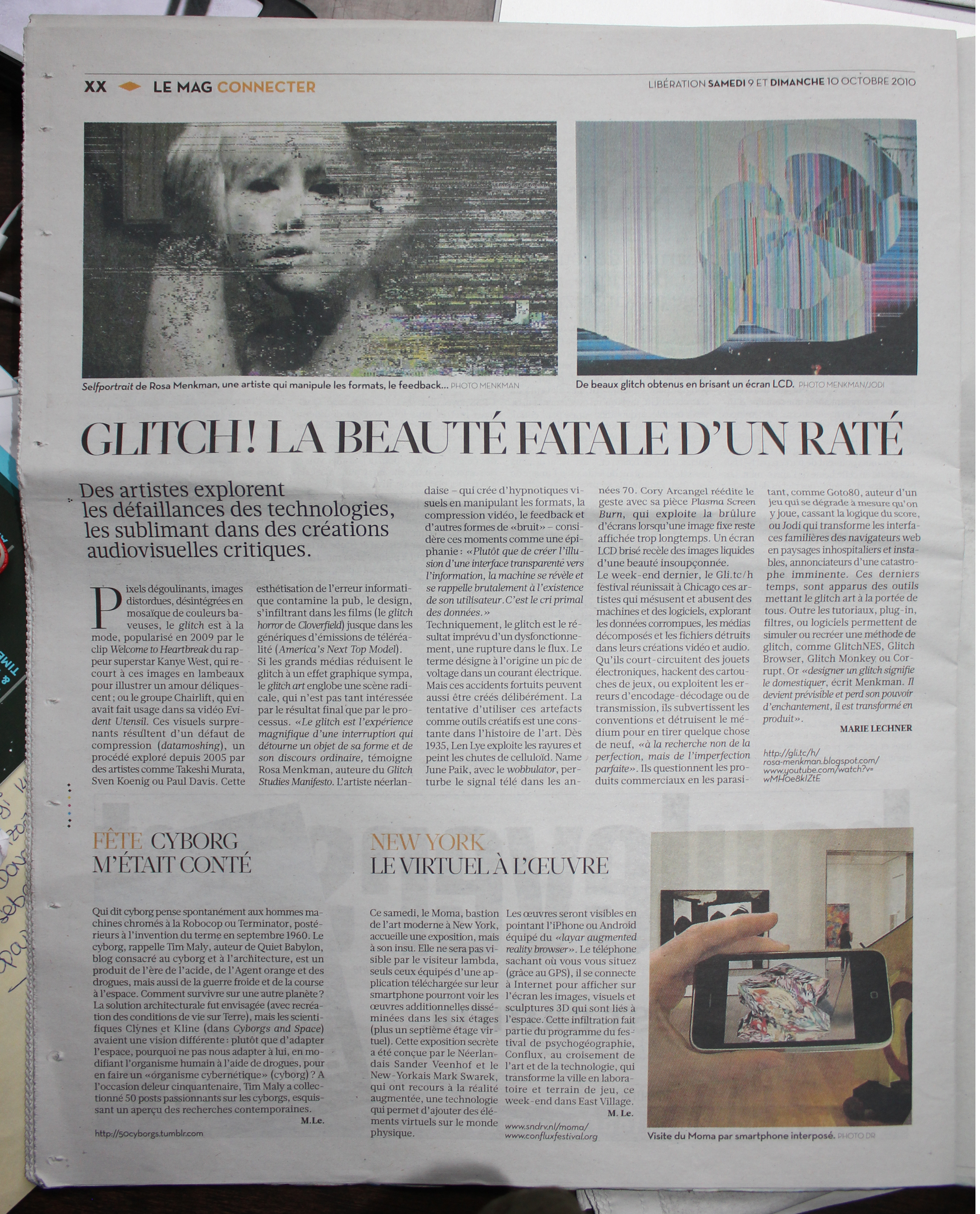
Glitch! la beauté fatale d’un raté by Marie Lechner

During my Databit.me La Libération (a national newspaper of France) featured half a page about me. Written by Marie Lechner, super nice! 
There were also 2 pieces in the regional newspapers La Provence and La Marseillaise  


///////////////////////////////////////////////////////////////////////////
///////////////////////////////////////////////////////////////////////////

Share Festival 2010 - Smart Mistakes

Share Festival 2010 - Smart Mistakes
This year, the VI Piemonte Share Festival will be focusing on the artistic and cultural significance of mistake, or: Smart Mistakes.

The festival will screen my video Demolish the Eerie ▼oid next to works by Jodi, 0100101110101101.org, Alterazioni Video, Lia, Miguel Carvalhais, Dextro, Ant Scott, Cory Arcangel, Nullsleep, Alison Maeley, Harm van den Dorpel, Stelarc, Mark Shepard and Michele Bazzan.

The exhibition will have 3 main clusters: technical error (glitches, the aesthetics of failure), biological error (mutations) and Serendipity (error as an opportunity):

Technical errors: glitches, the aesthetics of failure. These will be works or performances that explore the dysfunction of machines, transmission errors, bugs, interferences, disorder, noise, communication errors, and incorrect use. The artists working on this cluster will explore error in the relationship between man and machine not as a technical problem, but as an artistic paradigm about the perception of error from a cultural point of view and as artistic opportunity.

Biological errors: mutation, bio-diversity, nature, science. These will be works or performances that use life and the living as their language, along with aspects of the scientific method. The artists use biological material to create so-called "hybrid" art projects that use biological matter or exploit the chemical properties of matter or behavioural aspects of the living. These works can be defined as bio-art or hybrid art.

Serendipity : unexpected changes, chance discoveries, unpredictable variants. These terms should be understood in their broadest sense, the result of failed projects, abandoned projects, disaster, inconvenience, misappropriation, side-effects, slip-ups, and flops. They concern design and discovery based on error or randomness in approach.

10/15/2010

//interview on Vague Terrain with Ben Baker-Smith

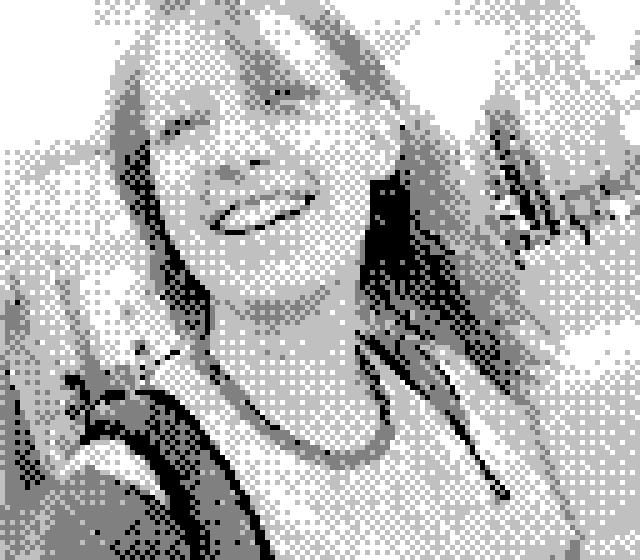
Rosa by Hellocatfood gameboy hifi wowowow
Gameboy camera photo by Hellocatfood /* Antonio Roberts /* during GLI.TC/H
This is another post that got stuck in my drafts that I did not get to publish for over a looong time. 

A While back Benjamin Baker-Smith published a group interview with glitch artists on Vague Terrain. I was one of the people that was interviewed. Now he also published the complete interview he did with me on his own website
Read it here