
Showing posts with label GlitchStudiesManifesto. Show all posts

3/09/2011

Video Vortex 11th and 12th of March and the Video Vortex || reader

(this is some small footage from my very first visual performance in Club 11, Amsterdam in 2008)
 
The first solo, visual performance I ever did was at Video Vortex #2 back in January 2008 (3 years ago!) in Amsterdam. Back then I never thought of myself as a performer, but Geert Lovink was convinced I was and so …it started. Since then, things have changed a lot for me and I could not be more thankful to Geert.
I am very excited that the Video Vortex conference will come back to Amsterdam this weekend. I have visited the conference 4 out of 6 times and every installment that I attended, I got myself involved in some kind of way (blogging, vlogging, performing, speaking). This year I will be part of Video Vortex through its publication (and by attendance): the Video Vortex reader 2 will feature a re-written version of the Glitch Studies Manifesto.
 
Besides this, if you did not find the time to visit the Filtering Failure exhibition, maybe you find time during Video Vortex, since the exhibition is right on the other side of the street!

4/19/2010

glitches vs glitch art


This week I am giving a week long workshop on file formats and how to deliberately break them, to reveal and use their structures and to create new audio-visual forms out of them. Of course the question "what is a glitch" came up. How does the glitch (the accident), to which I refer a lot in the workshop, relate to this practice? I have written about the same question in the Glitch Studies Manifesto, but never posted my perspective on this problem directly on my blog. I think it is the right time to re-post the particular paragraphs from the manifesto here.

Glitch vs glitch art
The glitch is a wonderful experience of an interruption that shifts an object away from its ordinary form and discourse. For a moment I am shocked, lost and in awe, asking myself what this other utterance is, how was it created. Is it perhaps ...a glitch? But once I named it, the momentum -the glitch- is no more...

But somewhere within the destructed ruins of meaning hope exists; a triumphal sensation that there is something more than just devastation. The negative feelings make place for an intimate, personal experience of a machine (or program), a system showing its formations, inner workings and flaws. As a holistic celebration the glitch can reveal a new opportunity, a spark of creative energy that indicates that something new is about to be created.
The glitch has no solid form or state through time; it is often perceived as an unexpected and abnormal mode of operandi, a break from (one of) the many flows (of expectations) within a technological system. But as the understanding of a glitch changes when it is being named, so does the equilibrium of the (former) glitch itself: the original experience of a rupture moved passed its momentum and vanished into a realm of new conditions. The glitch has become something new and has become an ephemeral, personal experience.

Glitch art
As an artist, I find catharsis in disintegration, ruptures and cracks. I manipulate, bend and break any medium towards the point where it becomes something new. This is what I call glitch art. Even so, to me, the word ‘glitch’ in ‘glitch art’ means something slightly different than the term ‘glitch’.
The genre of glitch art moves like the weather; sometimes it evolves very slowly while at other times it can strike like lightning. The art works within this realm can be disturbing, provoking and horrifying. Beautifully dangerous, they can at once take all the tensions of other possible compositions away. These works stretch boundaries and generate novel modes; they break open previously sealed politics and force a catharsis of conventions, norms and believes.
Glitch art is often about relaying the membrane of the normal, to create a new protocol after shattering an earlier one. The perfect glitch shows how destruction can change into the creation of something original. Once the glitch is understood as an alternative way of representation or a new language, its tipping point has passed and the essence of its glitch-being is vanished. The glitch is no longer an art of rejection, but a shape or appearance that is recognized as a novel form (of art). Artists that work with glitch processes are therefore often hunting for the fragile equilibrium; they search for the point when a new form is born from the blazed ashes of its precursor.
Even so, glitch art is not always (or by everyone) experienced as an art of the momentum; many works have already passed their tipping point. This is because glitch art exists within different systems and can be perceived differently by the different actors within these systems (for instance the system of production and the system of reception). Not only the artist who creates the work of glitch art is responsible for the glitch. The 'foreign' input (wrongly encoded syntaxes that lead to forbidden leakages and data promiscuity), the hardware and the software (the 'channel' that shows functional? collisions) and the audience (who is in charge of the reception, the decoding) can also be responsible. All these actors are positioned within different (but sometimes overlapping) flows in which the final product can be described or recognized as glitch art. This is why an intended error can still be called glitch art and why glitch art is not always just a personal experience of shock, but also (as a genre) a metaphor for a way of expression, that depends on multiple actors.
Over time some of the glitches I made developed into personal archetypes; I feel that they have become ideal examples or models of my work. Moreover, some of the techniques I (and others) used became easily reproducible for other people, either because I explained my working process, or sometimes because of the development of a software or plugin that automatically simulated or recreated a glitching method (that then became something close to an ‘effect’). I noticed that these kinds of normalizations or standardizations happen very often. Therefore, to me, the popularization and cultivation of the avant-garde of mishaps has become predestined and unavoidable.
The procedural essence of glitch art is opposed to conservation; the shocking experience, perception and understanding of what a glitch is at one point in time, cannot be preserved to a future time. The beautiful creation of a glitch is uncanny and sublime; the artist tries to catch something that is the result of an uncertain balance, a shifting, un-catchable, unrealized utopia connected to randomness and idyllic disintegrations. The essence of glitch art is therefore best understood as a history of movement and as an attitude of destructive generativity; it is the procedural art of non con-formative, ambiguous reformations.
Nevertheless, some artists do not focus on the procedural entity of the glitch. They skip the process of creation-by-destruction and focus directly on the creation of a formally new design, either by creating a final product or by developing a new way to recreate the latest archetype. This can for instance result into a plug-in, a filter or a whole new 'glitching software'.
This form of 'conservative glitch art' focuses more on design and end products then on the procedural breaking of flows and politics. There is an obvious critique: to design a glitch means to domesticate it. When the glitch becomes domesticated, controlled by a tool, or technology (a human craft) it has lost its enchantment and has become predictable. It is no longer a break from a flow within a technology, or a method to open up the political discourse, but instead a cultivation. For many actors it is no longer a glitch, but a filter that consists of a preset and/or a default: what was once understood as a glitch has now become a new commodity.
But for some, mostly the audience on the receptive end, these designed errors are still experienced as the breaks of a flow and can therefore righteously be called glitches. They don’t know that these works are constructed via the use of a filter. Works from the genre ‘glitch art’ thus consist as an assemblage of perceptions and the understanding by multiple actors. Therefore, the products of these new filters that come to existence after (or without) the momentum of a glitch cannot be excluded from the realm of glitch art.
Even so, the utopian fantasy of 'technological democracy' or 'freedom' that glitch art is often connected to, has little to do with the colonialism of these glitch art designs and glitch filters. If there is such a thing as technological freedom, this can only be found within the procedural momentum of glitch art, -when a glitch is just about to relay a protocol.

[this text is part of the glitch manifesto and is thus a my personal reflection on the glitch vs glitch art. I published it here also because it is a very important primer to understand my research that I post on this website]

̱͇̒

4/01/2010

//Vanishing Lines

By Doung Jahangeer and Rosa Menkman.
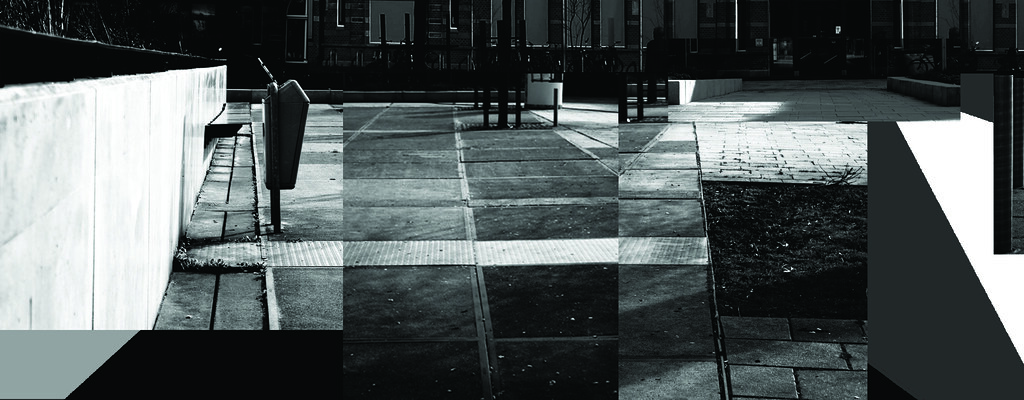
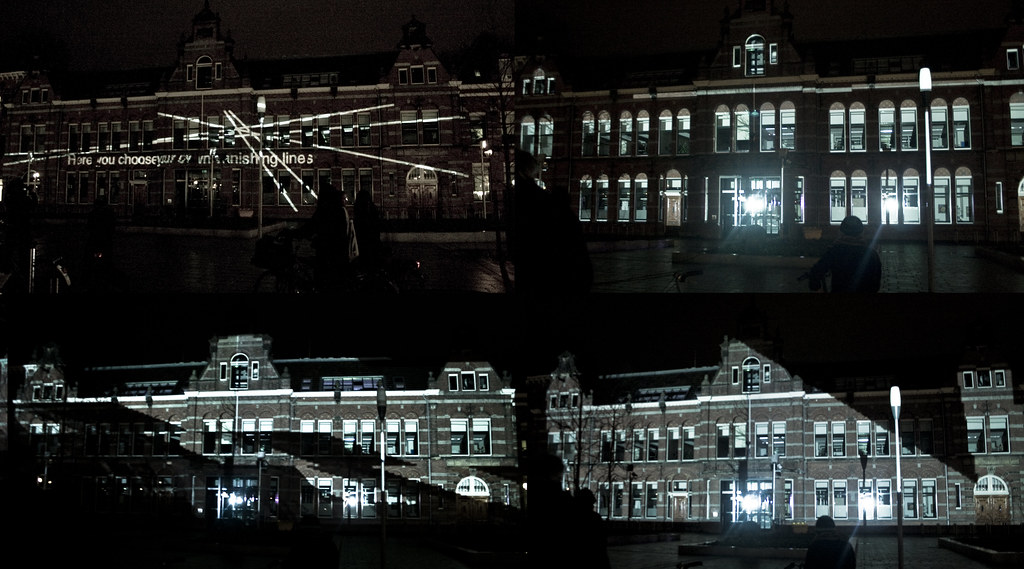
Vanishing linesSite specific projection for the Stadsdeelkantoor, Westerpark, Amsterdam. Made during The Media City workshop at NIMK. Projected on the 2nd of April.
During The workshop, I met Doung
Jahangeer who lives and works in South Africa. His work is based on the cracks within (social) architectures, that allow the explorer to define and create new, other space.
In his presentation on Tuesday (23th of March) Doung presented his manifesto on architecturewithoutwalls (to be published), which had a lot of similarities with both my glitch studies manifesto and in-between manifesto. We explored these connections within the small text we wrote that formed the basis of our collaborative projected
"Vanishing Lines".
Vanishing Lines documentation

Vanishing Lines // Vanishing Points
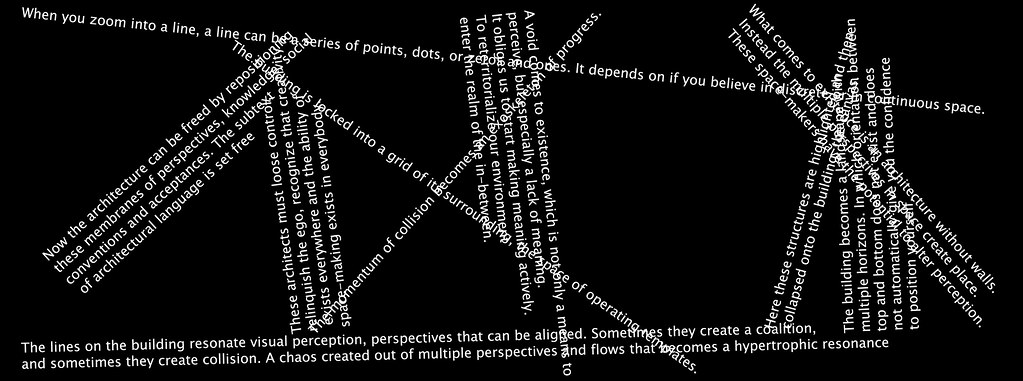
The creation of space as a concept as well as a practice, cannot be defined within entities, but is defined between different entities, and their perspectives. The architecture of space is in-between, and always multi-layered.
In Vanishing Lines, the building is locked into a grid of its surrounding; the space of operating templates, the grid of the Westerpark. These structures are highlighted and then collapsed onto the building, the canvas.
The lines on the building resonate visual perception; different perspectives are being aligned. Sometimes they create a coalition, and sometimes they create collision. A construction created out of multiple perspectives that evolve into a hypertrophic resonance.
The architecture can be freed by repositioning the membranes of perspectives. In this instance, the subtext of architectural language is set free. What comes to existence is an architecture without walls.
In this architecture without walls, the multiple perspectives in space create place. These space-makers provide the potential to alter perception.
Architects must learn to loose control and recognize that creativity exists everywhere: because the ability of space-making exists in everybody.
In Vanishing Lines, for a moment, the building has become a landscape with multiple horizons, in which orientation between top and bottom does not exist.
The landscape is artificial. It exists in-between the dichotomy of the real but totally constructed horizon and a digital fantasy horizon. The architecture does not automatically give the viewer the confidence to position himself, but instead, the viewer has to reterritorialize his environment and in so doing, he is forced to choose his own vanishing lines.

░░░░░░░░░░░░░░░░░
░░░░░░░░░░░░░░░░░░░░░░░░░░░░░░░░░░░░░░░░░░░░░░░░░░░░░░░

After writing the basic text we went to the site to make photos and draw up the grid (virtual and real) that exist around the building.
Vanishing Lines documentationVanishing Lines documentation
We drew lines on the grid, that formed a new architectural shape, and placed parts of the text on top of this shape. With the help of some digital glitches, we collapsed this shape, which formed a new space construction.
The first movie I made was high contrasted red and black, but it did not print nicely on the brick building :: the red light did not reflect at all, and the text was not readable because of the 3d surface. In fact in further testing it became clear that only few colors reflected and only hard shaped edges and abstract images were recognizable - the photos were unfortunately unusable. This is why I changed the pace and build up of the video - more basic, simple with contrasts in colors and speed.
Vanishing Lines documentationVanishing Lines documentation
the result is a very basic video, that did work well on the building. the soundtrack based on Goto80s MCMCMC made it perfect. The
video is centered around the idea that we can choose and create our own vanishing lines.
Video documentation will be added soon.

(Music by Goto80: parts of MCMCMC)

░░░░░░░░░░░░░░░░░░░░░░░░░░░░░░░░░░░░░░░░░░░░░░░░░░░░░░░░░░░░░░░░░░░░░░░░

1/31/2010

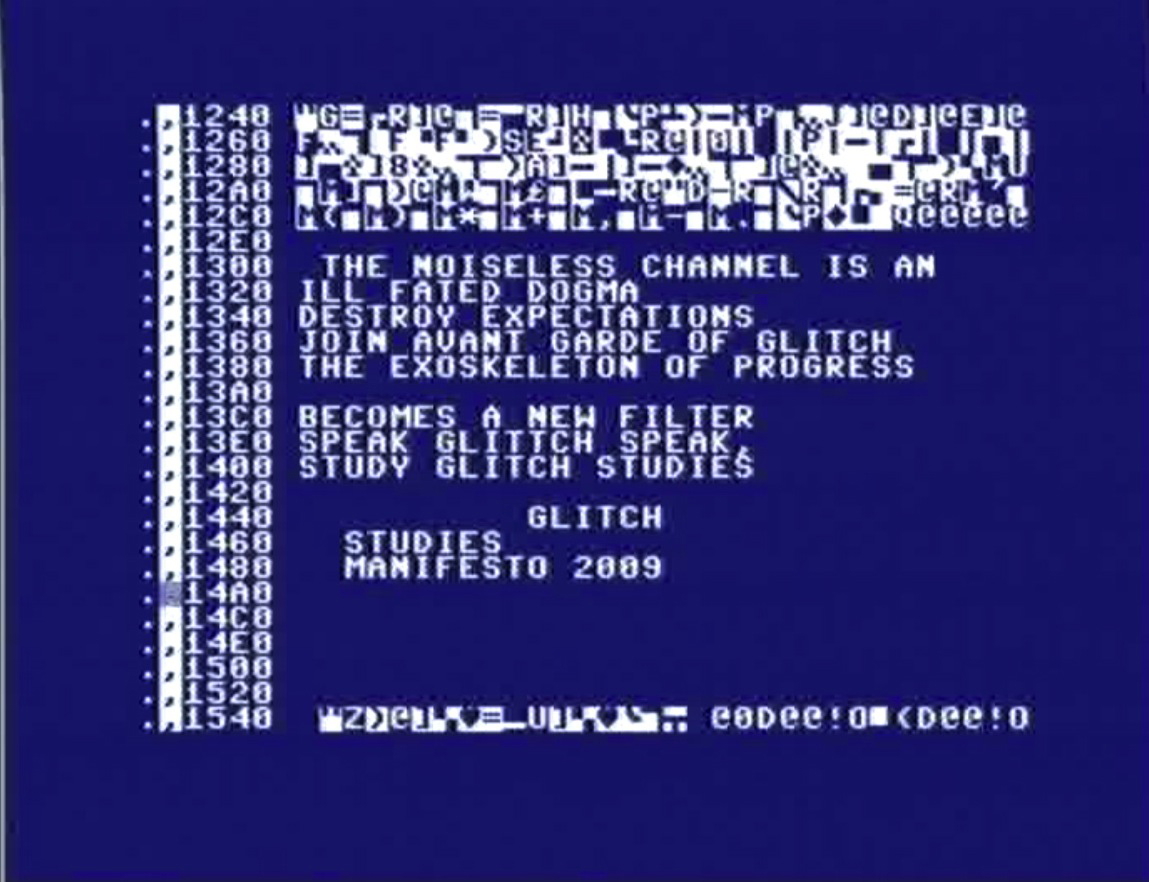
Glitch Studies Manifesto


go backwards to navigate forward!
The Glitch Studies Manifesto is now ready to be read and destroyed! It is available here!

1/30/2010

//Video Vortex Video registration

I presented the Glitch Studies Manifesto @ Video Vortex in the atomium. Here are the powerpoints I used.

Registration of my presentation of the glitch manifesto in the atomium in Brussels. Crowds still get the best of me, especially in the beginning the nerves were eating me alive.
The full glitch manifesto can be found here

12/11/2009

// Live:: Glitch Studies Manifesto ft. Goto80 on tv & internet!

glitch studies manifesto Live ft Goto80Tomorrow (12/12) me and Goto80 will perform the glitch studies manifesto at Montevideo (the Dutch institute of Media art NIMK, Amsterdam) as part of the media playgrounds program. Regional Dutch television will be there to broadcast the performance live on television and via Internet. You can tune in here. We have never worked with a 'storyboard' before, so expect an experimental 1.0 glitch performance! The program: * 01:00-01:15 Interviews by David Garcia with Rosa Menkman / Goto80 * 01:15-01:35 Glitch Studies Manifesto: Rosa Menkman / Goto80

11/20/2009

Glitch Studies Manifesto (6/7/8/9/10)


Glitch Studies Manifesto
[short, first version]. Longer parts can be found here.


1. The dominant, continuing search for a noiseless channel has been, and will always be no more than a regrettable, ill-fated dogma.
Even though the constant search for complete transparency brings new, ‘better’ media, every one of these new and improved techniques will always have their own fingerprints of imperfection.

2. Dispute the operating templates of creative practice by fighting genres and expectations!
We are all stuck in the membranes of knowledge, governed by social conventions and acceptances. As an artist I strive to reposition these membranes; I do not feel locked into one medium or between contradictions like real vs. virtual or digital vs. analog. Fight the techno religion! Surf (tube- ride) the vortex of technology, the art of artifacts.

3. Get away from the established action scripts and join the avant-garde of the unknown. Become a nomad of noise artifacts!
There are three occasions when the static, linear notion of transmitting information can be interrupted. These instances often result into noise artifacts, sub-divisible as glitch, encoding / decoding (compression) and feedback artifacts.

4. Use the glitch as an exoskeleton of progress. Find catharsis in disintegration, ruptures and fractures.
Manipulate, crack and break different actors: bend them towards the point where they become something new.

5. The gospel of glitch art sings about new models implemented by corruption.
The popularization and cultivation of the avant-garde of mishaps appears to be predestined and unavoidable. Glitches have often shown to be the early development of a next fashion, or the creation of a new archetype. These new, enchanting forms seem to be inevitably connected to the creation of new filters. Moreover, in contemporary culture, we are so used to data fraud that the ‘right way of using' does not exist anymore; instead, misuse and abuse have become new commonalities.

6. The ambiguous contingency of the glitch technotext depends on its constantly mutating materiality.
The materiality of the glitch art is not (just) the machine the work appears on. The glitch exists as an unstable assemblage in which on the one hand the construction, operation and content of the apparatus (the medium) and on the other hand the work, the writer, and the interpretation by the reader and/or user (the meaning) influence its materiality.

7. Glitch artifacts are critical trans-media aesthetics.
They are not only used to show any kind of medium in a state of hypertrophy, but also to criticize the inherent politics. I bring any medium in a critical state and while criticizing it!

The role of artifacts in critical trans media aesthetics is two fold:
* They show a medium in a critical state (ruined, unwanted, not recognized, accidental and horrendous state)
* They critique the medium (genre, interface and expectations)
Accidents transform the way we see the normal. Every accident transforms the normal
Political: they challenge the established template of creative practice and the production of theory and reflection.

8. Translate acousmatic noise and soundscapes into acousmatic video and videoscapes to create conceptual synesthesia.

The obfuscated box of technology is the new veil that shrouds the source of the output.
When artifacts from both the aural and the visual realm are used as criticial media aesthetics, they form the opportunity to create a conceptually synesthetic artwork. An artwork where synesthesia is not just a metaphor for transcoding one medium upon another, but a conceptually driven meeting of the visual and the sonic (or maybe even other senses).


9. Speak the totalitarian language of disintegration
Glitchspeak is a vocabulary of unknown rhetorics. It is not just a new, unknown form, but also an exoskeleton of progress: a new generativity.

10. Study what is outside of knowledge and teach Glitch studies! Theory is just what you can get away with!
Just like Foucault stated that there can be no reason without madness, Virilio described that there is no technological progression without the inherent accident and Gombrich describes noise in terms of breaks from patterns, we cannot understand flow without its interruption, noise without order, transparency without artifacts or glitch without a presumed function. This is why there is a need for Glitch Studies.
Glitch theory is just what you can get away with!

11/06/2009

Glitch Studies Manifesto (5)

5. The gospel of glitch art sings about new models implemented by corruption. The popularization and cultivation of the avant garde of mishaps appears to be predestined and unavoidable. Glitches have often shown to be the early development of a next fashion, or the creation of a new archetype. These new, enchanting forms seem to be inevitably connected to the creation of new filters. Moreover, in contemporary culture, we are so used to data fraud that the ‘right way of using' does not exist anymore; instead, misuse and abuse have become new commonalities. Like in poetry, in glitch art one perception immediately leads to a next perception. Glitch art is all about relaying the membrane of the normal; to create a new protocol after breaking the earlier one. The perfect glitch shows how destruction can change into the creation of something new, while at the same time this creation annihilates an otherwise infinite realm of possibilities. Once the glitch is understood as an alternative way of representation or a new language, its tipping point has passed and the essence of its glitch-being is vanished. The glitch is no longer an art of rejection, but a shape or appearance that is recognized as a new form (of art). Artists that work with glitch processes are therefore often hunting for a fragile equilibrium; they search for the point when a new form is born from the blazed ashes of its precursor. The procedural essence of glitch art is therefore often opposed to conservation; the experience, perception and understanding of what a glitch is at one point in time cannot be preserved to a future time. The beauty of creation of a glitch is uncanny and sublime; the artist is trying to catch something that is the result of an uncertain balance, a shifting, un-catchable, unrealized utopia connected to randomness of idyllic disintegrations. The essence of glitch art is therefore best understood as a history of movement and as an attitude of destructive generativity; it is the procedural art of non con-formative, ambiguous reformations. Some artists do not focus on the procedural entity of the glitch. They skip the process of creation-by-destruction and focus directly on the creation of a formally new design, either by creating a final product or a new way to recreate the latest archetype (that is not yet by everybody recognized). These works help by the creation of, or sometimes even create are a plugin, a filter or a new 'glitching' software. This form of 'conservative glitch art' focuses more on design and end-products then the procedural breaking of flows. We can voice an obvious critique; to design a glitch means to domesticate it. When the glitch becomes domesticated, controlled by a tool, or technology (a human craft) it has lost it enchantment and has become predictable. It is no longer a break from a flow within a technology, or a method to open up the political discourse but instead a (new) cultivation. For many actors it is no longer a glitch, but a filter that consists of a preset and/or a default, it has become just a new commodity. But for some (mostly the actors that take part on the receptive end), these designed glitches are still experienced as breaks or errors in a flow. Glitch art consists of an assemblage of perceptions by multiple actors. Therefore, these new filters that come to existence after the momentum of glitch cannot be excluded from the realm of glitch art. Even so, the utopian fantasy of 'technological democracy' or 'freedom' that glitch art is often connected to, has little to do with the colonialism of these new glitch art archetypes, designs and glitch filters. If there is such a thing as technological freedom, this can only be found within the procedural momentum of glitch art, -when it is just about to relay a protocol.

11/02/2009

Glitch Studies Manifesto (4)

4. Use the glitch as an exoskeleton of progress. Find catharsis in disintegration, ruptures and fractures. Manipulate, crack and break different actors: bend them towards the point where they become something new. The glitch is a wonderful interruption that shifts an object away from its ordinary form and discourse. For a moment I am lost, in awe, asking myself what this other utterance is, how was it created. Is it perhaps ...a glitch? But once I named it, the momentum -the glitch- is no more... The glitch has no solid form or state through time; it is an ephemeral, unexpected, abnormal mode of operandi, a break from (one of) the many flows, a grinch. As my understanding of the glitch changed and I named it, so did the equilibrium of the (former) glitch itself: it has vanished into the realm of new conditions. Determining what a glitch is, is often misunderstood as a subjective act. We have to realize that the glitch depends on more than just a personal or even a social definition. The glitch involves different levels of reading at the same time: it is a form of micro-politics that causes breaks within technological, social, political and many other (flows within) systems. As semantic terrorism within an irrational matrix it temporarily voids all possibilities for understanding. But somewhere within these constructed ruins of meaning a feeling of triumph exists; a hopeful feeling that there is something more than just destruction. The negative feeling makes place for an intimate experience of a machine (or program), a system showing its formations and its flaws – as a holistic celebration rather than a particular perfection it reveals a new opportunity, or a spark of creative energy. A feeling that something new is about to be created. The derivative art form, conveniently called 'glitch art', moves like the weather; sometimes it evolves very slowly while at other times it can strike like lightning. The art works within this realm can be disturbing, provoking and horrifying. Beautifully dangerous, they can at once take all the tensions of other possible compositions away. These works stretch boundaries and generate new possibilities: as an avant-garde of mishaps they break up previously sealed politics and force a catharsis of conventions, norms and believes. But the word 'glitch' within 'glitch art' means more than just the technological definition of glitch. Glitch art does not just take place on a surface, and does not just disappear after its tipping point. This art form is also about what happens after the tipping point, how media transgress into a new mode and even what happens after this transgression (the normalization). This mode can be continuous, or exist just as a reflection (a memory) in our mind. Furthermore, it can choose to focus on the procedural, or more on a final design. One way or the other, the choice to 'accept' the glitch by naming it (glitch art) and to welcome it as a new form, means to accept change and to welcome a new dialectic. Glitch art is therefore not always (or by everyone) experienced as an art of the momentum; many works have already passed their tipping point and are now created by a new method and exist as a new, recognizable form, the design of glitch. Glitch art not only depends on its system but also on the different actors within these systems. Not only the artist who creates the work of glitch art is 'responsible' for the glitch. The 'foreign' input (wrongly encoded syntaxes that lead to forbidden leakages and data promiscuity), the hardware and the software (the 'channel' that shows functional? collisions) and the audience (who is in charge of the reception, the decoding) can also be responsible. All these actors are positioned within different (but sometimes overlapping) flows of which the final product can be described or recognized as glitch art. Another reason to call these works of intended, controlled glitch art 'glitchy', is because these works exists within different systems of perception; for instance the system of production and the system of reception. While the artist might not call his production method glitchy, the audience could still believe in the glitchy-ness of the result. This is why an intended error can still be called erroneous (glitchy).

11/01/2009

Glitch Studies Manifesto (3)

3. Get away from the established action scripts and join the avant-garde of the unknown. Become a nomad of noise artifacts! There are three occasions when the static, linear notion of transmitting information can be interrupted. These instances often result into noise artifacts, sub-divisible as glitch, encoding / decoding (compression) and feedback artifacts. Etymologically, the term “noise” refers to states of aggression, alarm and powerful sound phenomena in nature ('rauschen'), such as storm, thunder and the roaring sea. But when we approach noise within a more social context, noise is often used as a figure of speech and as such has many meanings. Sometimes, noise stands for unaccepted sounds, not music, not valid information or what is not a message. This negative definition also has a positive consequence: it can help by defining its opposite (the world of meaning, the norm, regulation, goodness, beauty and so on). Moreover, noise often helps to contextualize information. Noise is thus paradoxical. It is the source for new patterns, anti patterns and new possibilities. Noise functions as a positive, generative quality (that is present in any communication medium) and exists on the border (the membrane) of language. I use the concept of noise to refer to an (often undesirable, unwanted, other and unordered) disturbance or addition to the linear signal of useful data; a void of meaning. This void can not only be used as a lack of meaning, but also as a power that forces the reader to move away from the traditional discourse around code, and to open it up, to understand the politics behind a text or technology. The void can bring the fundaments of communication that are normally obfuscated or the elements that we don't want to see to the surface; it can expose hierarchies. Through the void, artists can voice a critique towards the digital media.

10/31/2009

Glitch Studies Manifesto (2)

2. Dispute the operating templates of creative practice by fighting genres and expectations! We are all stuck in the membranes of knowledge, governed by social conventions and acceptances. As an artist I strive to reposition these membranes; I do not feel locked into one medium or between contradictions like real vs. virtual or digital vs. analog. Fight the techno religion! Surf (tube- ride) the vortex of technology, the art of artifacts. The quest for complete transparency has changed the computer system into a highly complex assemblage that is often hard to penetrate, or sometimes even completely closed off. This system consists of layers of obfuscated protocols that find their origin in ideologies, economies, political hierarchies and social conventions, which are subsequently operated by different actors. I elucidate and deconstruct the hierarchies of this system of assemblage. I do not work in (binary) opposition to what is inside the flows (the normal uses of the computer) but practice on the border of these flows. Sometimes, I use the computers’ inherent maxims as a façade, to trick the audience into a flow of certain expectation that the artwork rapidly breaks out of. As a result, the spectator is forced to acknowledge that the use of the computer is based on a genealogy of conventions, while in reality, the computer is a machine that can be bent or used in many different ways. With the creation of breaks within politics and social and economical conventions, the audience may become aware of the preprogrammed patterns and a distributed awareness of a new interaction gestalt can take form.

10/28/2009

Glitch Studies Manifesto (1)

1. The dominant, continuing search for a noiseless channel has been, and will always be no more than a regrettable, ill-fated dogma. Even though the constant search for complete transparency brings new, ‘better’ media, every one of these new and improved techniques will always have their own fingerprints of imperfection. In the beginning there was only noise. Then we moved from the grain of celluloid to the magnetic distortion and scanning lines of the cathode ray tube. We wandered the planes of phosphor burn-in, rubbed away our dead pixels and eventually watched performance art created by cracking LCD screens. The elitist discourse of the upgrade is a dogma widely pursued by the naive victims of a persistent upgrade culture. The consumer only has to dial #1-800 to stay on top of the technological curve, the waves of euphoria and disappointment. It has become normal that in the future we will pay less for a device that can do more. We have to realize that improving is nothing more then a proprietary protocol, a deluded consumer myth about progression towards a holy grail of perfection.